





Budget vs Premium Women’s Leather Motorcycle Vests: Which Is Worth It?
You’re looking at two vests. One costs $99. The other costs $350. Both are leather. Both look similar in photos. Both claim to be “quality motorcycle gear.” So what’s actually...

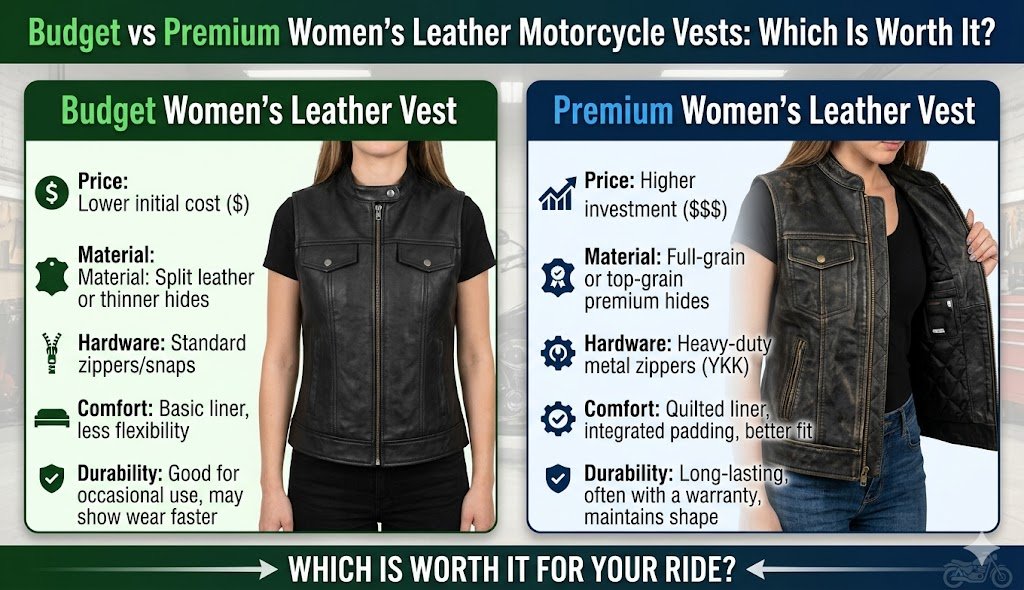
Table Of Content
- What You Actually Get at Different Price Points
- Budget Range ($80–$150)
- Mid-Range ($150–$250)
- Premium Range ($250–$400+)
- Leather Quality: Where Price Shows First
- Thickness and Weight
- Leather Grade
- Tanning and Finishing
- Construction Differences That Matter
- Stitching Quality
- Panel Design
- Lining and Interior Finish
- Hardware: Zippers, Snaps, and Details
- Zippers
- Snaps and Buttons
- Side Laces
- Fit and Sizing Accuracy
- Longevity and True Cost Over Time
- Who Should Buy Budget vs Premium
- Buy Budget If
- Buy Premium If
- The Middle Ground
- What Premium Doesn’t Always Mean
- Making Your Decision
- The Bottom Line
You’re looking at two vests. One costs $99. The other costs $350. Both are leather. Both look similar in photos. Both claim to be “quality motorcycle gear.”
So what’s actually different? And more importantly, which one should you buy?
The gap between budget and premium women’s leather motorcycle vests is real, but it’s not always where you think it is. Some premium vests justify every dollar. Others charge extra for branding and marketing while using materials barely better than budget options.
Here’s what actually separates the price points and how to decide which makes sense for how you ride.
What You Actually Get at Different Price Points
Let’s start with honest ranges and what typically comes with each.
Budget Range ($80–$150)
At this price, you’re getting basic leather construction. The vest will be functional, but corners are cut to hit the price point. Expect thinner leather (0.8–1.0mm), simplified construction with fewer panels, basic hardware, and minimal finishing details. Linings are often synthetic or absent entirely.
Mid-Range ($150–$250)
This is where quality starts improving noticeably. Leather thickness increases to 1.0–1.2mm, construction quality gets better with reinforced stitching, hardware upgrades to more durable snaps and zippers, and you’ll see features like interior pockets and better fit tailoring.
Premium Range ($250–$400+)
Premium women’s leather biker vests use top-grade leather (1.2mm+), expert-level construction with attention to detail, quality hardware that lasts years, thoughtful design with ergonomic fit, and finishing touches like hand-stitched details or decorative elements that don’t fall off after one season.
The question isn’t whether premium vests are better, they are. The question is whether that difference matters for how you use the vest.
Leather Quality: Where Price Shows First
The leather itself is the biggest differentiator between budget and premium vests.
Thickness and Weight
Budget vests typically use 0.8–1.0mm leather. It’s thin enough to keep costs down but also thin enough that abrasion resistance suffers. You’ll feel the difference immediately, budget leather feels lighter, more papery.
Premium vests use 1.2–1.4mm leather. Thicker leather means better protection in a slide, longer lifespan, and a vest that holds its shape over time instead of becoming floppy after a few seasons.
Leather Grade
Budget vests often use lower-grade hides with more imperfections. Manufacturers cover these with heavy pigments or finishes, which looks uniform when new but doesn’t age well. The leather can’t breathe as well, and the finish cracks or peels over time.
Premium vests use top-grain or full-grain leather with minimal surface treatment. The natural grain shows through, the leather breathes better, and it develops a rich patina with age instead of just looking worn out.
Tanning and Finishing
Cheaper tanning processes save money but result in leather that stiffens quickly, absorbs water more readily, and requires more frequent conditioning. Premium tanning processes produce leather that stays supple longer, resists moisture better, and requires less maintenance.
Construction Differences That Matter
How a vest is put together affects both how it fits and how long it lasts.
Stitching Quality
Budget vests use single-needle stitching with synthetic thread. It holds the vest together but isn’t reinforced at stress points. Seams can pull apart at shoulders, armholes, or side laces after a season or two of regular wear.
Premium vests feature double or triple stitching at critical areas, use stronger nylon or polyester thread, and reinforce high-stress points like armholes and pocket corners. The stitching is straighter, tighter, and won’t blow out under normal use.
Panel Design
Budget vests often use a simple two-panel design, front and back, with minimal shaping. This keeps cutting and sewing costs down but results in a boxy fit that doesn’t conform to a woman’s body.
Women’s leather motorcycle vests use multi-panel construction with darts and contouring that follow natural curves. The result is a vest that fits better, moves with you, and doesn’t gap at the armholes or pull across the chest.
Lining and Interior Finish
Budget vests either skip the lining entirely or use cheap polyester that pills and tears. Unfinished seams on the inside can be rough against skin or base layers.
Premium vests include quality linings, often satin or breathable synthetic, with finished seams that look as good inside as outside. Some include interior pockets for valuables, which budget vests rarely offer.
Hardware: Zippers, Snaps, and Details
The small stuff adds up fast.
Zippers
Budget vests use generic zippers that stick, snag, or break within a year. Zipper pulls are flimsy and sometimes fall off.
Premium vests use YKK or similar quality zippers that operate smoothly, resist corrosion, and last the life of the vest. Zipper pulls are reinforced and easy to operate with gloves on.
Snaps and Buttons
Cheap snaps loosen quickly or pop off entirely. Button threads fray and buttons fall off after repeated use.
Quality hardware stays secure. Snaps have strong retention, buttons are bar-tacked with reinforced stitching, and everything is sized appropriately for the weight of the leather so closures don’t strain.
Side Laces
Budget vests use thin laces that stretch, fray, or break. Grommets are poorly set and pull out of the leather.
Premium vests use thick leather laces or durable synthetic cord with properly reinforced grommets that won’t tear out. The lacing has enough length for real adjustment range.
Fit and Sizing Accuracy
This is where women especially notice the difference.
Budget vests are often unisex patterns sized down, which means they fit men’s proportions in smaller dimensions. Shoulders are too wide, armholes gape, and there’s no waist definition.
Top notch women’s leather motorcycle vests are designed from the ground up for women’s bodies. Shoulders sit correctly, chest room is proportional, waist tapers appropriately, and armholes are sized and positioned for women’s builds. The result is a vest that looks fitted instead of borrowed from someone else’s closet.
Sizing consistency also improves at higher price points. Budget brands have wildly inconsistent sizing, a medium from one batch fits like a large from another. Premium brands maintain tighter tolerances, so their size charts are actually reliable.
Longevity and True Cost Over Time
Here’s where the math gets interesting.
A $100 budget vest that lasts two seasons before the leather cracks, stitching fails, or it just looks too beat up to wear costs you $50 per year.
A $300 premium vest that lasts ten years costs you $30 per year.
The upfront cost is higher, but the per-year cost is lower. If you ride regularly and plan to keep riding, premium is often the better financial choice.
Budget vests make sense if you’re genuinely unsure whether you’ll stick with riding, if you’re between sizes and expect your body to change, or if you truly can’t afford the upfront cost of premium gear.
Who Should Buy Budget vs Premium
Buy Budget If:
- You’re new to riding and testing whether you’ll stick with it
- You need a vest immediately but plan to upgrade later
- You ride infrequently (a few times a year)
- Your budget genuinely won’t stretch to premium pricing
- You’re between sizes or body changes are expected
Buy Premium If:
- You ride regularly and plan to continue
- You want gear that lasts years, not seasons
- Fit and comfort matter to you
- You’ve had budget gear fail and want something reliable
- You can afford the upfront investment
The Middle Ground
Mid-range vests ($150–$250) often offer the best value. You get significantly better quality than budget without paying for premium brand markup. If you’re not sure which tier makes sense, start here.
What Premium Doesn’t Always Mean
Higher price doesn’t automatically mean better value. Some premium-priced vests charge extra for:
- Brand names and logos
- Decorative details that don’t improve function
- Fashion styling over riding functionality
- Retail markup from boutique stores
Check what you’re actually getting. A $350 vest with thin leather and basic construction isn’t premium, it’s overpriced. Compare specs, read reviews from actual riders, and verify materials before assuming price equals quality.
Making Your Decision
Ignore the price tag for a minute. Ask yourself:
- How often will I actually wear this vest?
- How long do I want it to last?
- Does fit quality matter enough to justify extra cost?
- Am I willing to replace budget gear in two years, or would I rather buy once?
If you ride every weekend, want gear that develops character instead of falling apart, and value fit and finish, premium makes sense.
If you’re testing the waters, ride occasionally, or genuinely can’t stretch your budget, a quality budget vest will serve you fine, just know its limitations and plan accordingly.
The worst choice is buying cheap, being disappointed, and then buying premium anyway. That’s paying twice.
The Bottom Line
Budget women’s leather motorcycle vests work. They’re not junk. But they’re built to a price, and that means compromises in materials, construction, and longevity.
Premium vests cost more because they use better leather, better construction, better hardware, and better design. Whether that’s worth it depends entirely on how you ride and what you value.
Buy the best you can afford without stretching your budget uncomfortably. A mid-range vest you can buy today beats a premium vest you’ll save for but never actually purchase.
Your vest should fit your riding, your budget, and your body. Get those three things right, and the price becomes less important than the value.


No Comment! Be the first one.