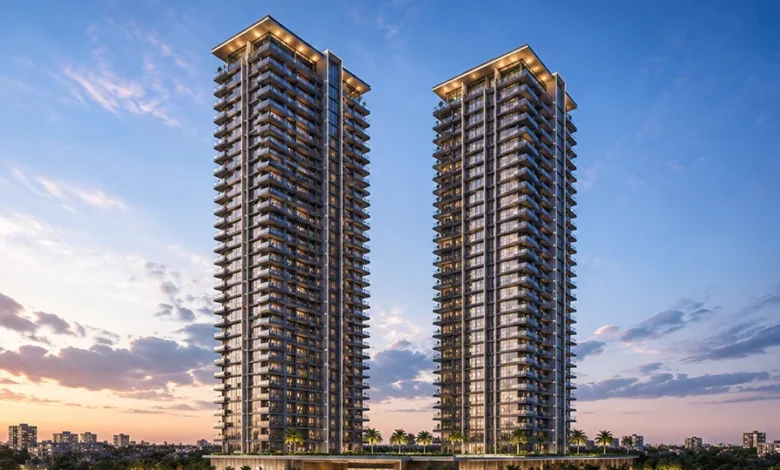
Delhi-NCR’s luxury housing prices rose roughly 72% in 3 years from about ₹13,450 a square foot in 2022 to ₹23,100 by the end of 2025, according to Anarock Research. That climb was steepest in homes priced above ₹1.5 crore, the band where the capital region now does most of its serious business. And it was no longer Gurugram carrying the whole story.
Money chasing premium homes in Delhi has started circling addresses that buyers wrote off a decade ago. Which is roughly how a real estate firm founded in Houston in 1957 ended up planning a high-rise community on the site of a closed cotton mill in North Delhi.
The site is the former Birla Cotton Mills land in Kamla Nagar, about 10.8 acres, a short walk from Delhi University’s North Campus. The project rising there, Elevate Delhi 7, is being developed with Hines, the American firm whose name sits on towers from Houston to London. For a neighbourhood better known for its book stalls and street food than its skyline, that is a genuine shift, and it is worth understanding why it is happening now rather than 5 years ago or 5 years from now.
The number that explains the bet
Start with the market, because the project only makes sense against it. Anarock pegged the Delhi-NCR luxury segment’s 3-year price jump at 72%, the highest of any housing tier in the region. Knight Frank India recorded a 19% year-on-year rise in capital values. Prop Equity’s read on the first quarter of 2026 was a 17.6% annual price increase, with new supply up 28.6% and sales still rising 11.4%. Prices went up; people kept buying anyway.
CBRE’s India Residential Market Outlook 2026 adds a useful caveat to the cheerleading: after years of sharp escalation, incomes are finally catching up to prices, and 2026 looks more like a stability phase than another sprint. In Gurugram’s premium corridors, rates climbed nearly 160% between 2019 and 2024 before settling around ₹19,500 a sq.ft. The easy money has been made there. What’s left is the search for the next under-priced address and central Delhi, where almost nothing new gets built, is an obvious candidate.
Why Kamla Nagar and not South Delhi or Gurugram
Kamla Nagar has the two things that matter most to a luxury developer and are hardest to manufacture: an established location and almost no competing supply. The area sits in the heart of North Delhi’s academic belt. Hindu, Hansraj and St. Stephen’s colleges are within a couple of kilometers; the University of Delhi’s North Campus is roughly 800 meters away, and Vishwavidyalaya Metro on the Yellow Line is about 1.2 km away. The Kamla Nagar and Hudson Lane markets are close enough to walk to. None of this had to be built; it has been there for generations.
What it has lacked is modern inventory. North Delhi is dense, old, and tightly held large land parcels almost never come free. The Birla Cotton Mills site is the rare exception: a 100-year industrial legacy whose closure left behind one of central Delhi’s last big developable plots. That scarcity is the whole investment thesis. A new gated high-rise in a locality dominated by ageing low-rise buildings doesn’t have to compete with ten similar launches down the road, because there aren’t any.
What a global name brings, and why it matters in 2026
The timing tracks a broader pattern. India now ranks 6th worldwide for live branded-residence projects and accounts for about 4% of global supply, according to Knight Frank India’s The Residence Report 2025; domestic supply has grown by roughly 160% over the past decade. Savills counted around 910 branded-residence projects globally by the end of 2025, up nearly 20% from a year earlier. The wave is visible across NCR Signature Global’s tie-up with Tonino Lamborghini in Gurugram, M3M’s planned ₹3,500-crore investment with Elie Saab. A global identity, the research consistently finds, tends to command a 20-35% premium over comparable unbranded luxury stock.
Hines is a different flavour of “brand” than a fashion house. Founded by Gerald D. Hines in 1957, the firm operates across roughly 30 countries and manages around USD 91.7 billion in assets a developer-operator rather than a logo licensed onto a tower. In Kamla Nagar it is working alongside Conscient Infrastructure, with Texmaco (Adventz) and HDFC Capital reported among the partners: global execution, local entitlement, and institutional capital in one stack. For a first residential move in Delhi, that combination is the actual product on offer, more than any single amenity.
Inside the plan: configurations, density and amenities
On the published details, Elevate Delhi 7 spans 10.8 acres with 6 high-rise towers and around 900 apartments, in 3 and 4 BHK configurations. The planning choice that stands out is density: roughly 900 homes across nearly 11 acres, with about 80% of the site kept as open and green space. In a part of the city defined by congestion, low density is itself the luxury. Detailed floor plans and unit sizes had not been officially released at the time of writing a point worth flagging for anyone comparing layouts, since unverified sizes are circulating on listing sites. The official information page for Elevate Delhi 7 in Kamla Nagar is the place to confirm them once published.
The amenity programme reads as resort-style rather than transactional: a clubhouse anchoring temperature-controlled and outdoor pools, a gymnasium, yoga and meditation zones, a spa and sauna, a kids’ play area and community spaces indoors; sports courts, a jogging track, an open gym, basketball and cricket nets, and landscaped gardens outside. The list matters less for the count than for what it signals a community designed so residents rarely need to leave it, which is the operating logic behind every well-run branded development.
The price question nobody can fully answer yet
Here is where honesty serves buyers better than hype. As of writing, Elevate Delhi 7’s pricing and floor sizes are officially listed as “coming soon.” Anything quoted beyond that and several numbers are floating around, should be treated as speculation until the developer publishes a rate card or RERA registration confirms the details (registration has been reported to be in process).
What can be said responsibly is the context. The Delhi-NCR luxury average sat near ₹23,100 a square foot at the end of 2025 per Anarock; branded product typically trades at a 20-35% premium to that; and Kamla Nagar carries a scarcity premium of its own because nothing comparable exists nearby. Put together, the project sits squarely in the high-luxury bracket, entry tickets that read in crores, not lakhs. The locality’s own fundamentals help explain the appetite: the official material cites annual appreciation in the 8-15% range and rental yields of 4-6%, the latter supported by steady tenant demand from the university belt. Treat those as the seller’s framing, not a guarantee, yields and appreciation both depend heavily on the eventual entry price.
The case for caution
No editorial worth reading would stop at the bull case. Three risks deserve weight. First, pricing: a category with no local comparables can be mispriced in either direction, and an aggressive launch number would compress the very appreciation buyers are counting on. Second, the absorption question North Delhi’s affluent buyers have historically preferred independent floors and builder homes over high-rise apartments; a project this large is partly a bet that those preferences are changing. Third, execution and timeline: a 3 and-4-BHK community of this scale is a multi-year build, and consortium projects carry their own coordination risk even with strong partners.
CBRE’s broader signal that NCR is moving from breakneck growth toward stability cuts both ways here. Stability is good for end-users who plan to live in their homes. It is less generous to investors who underwrote the past 3 years’ double-digit jumps and expect them to simply continue.
What to watch
Strip away the marketing and Elevate Delhi 7 is a clean test of a single idea: that central Delhi’s last large parcels, in the hands of global operators, can support the kind of high-rise luxury that Gurugram spent a decade normalising. The location is real, the scarcity is real, and the developer pedigree is real. The two open variables are the launch price and whether North Delhi’s buyers embrace vertical living at this tier.
The next 12 to 18 months the rate card, the RERA registration, and the early sales velocity, will say more than any brochure. For anyone tracking where Delhi’s luxury market goes after Gurugram, a cotton mill in Kamla Nagar is suddenly one of the more interesting things to keep an eye on.
Read more: https://www.elevatedelhi7.com/blog/elevate-delhi-7-kamla-nagar-price-floor-plan-2026/
Frequently Asked Questions
Who is developing Elevate Delhi 7 in Kamla Nagar?
Elevate Delhi 7 is being developed in association with Hines, the global real estate firm founded in Houston in 1957, alongside Conscient Infrastructure. Texmaco (Adventz) and HDFC Capital have been reported among the project’s partners, giving it a mix of global development experience, local execution and institutional capital.
Where exactly is Elevate Delhi 7 located?
It sits in Kamla Nagar, North Delhi, on roughly 10.8 acres of the former Birla Cotton Mills land. The location is about 0.8 km from Delhi University’s North Campus and around 1.2 km from Vishwavidyalaya Metro station on the Yellow Line.
What is the price of Elevate Delhi 7 Kamla Nagar?
Official pricing is listed as “coming soon” at the time of writing, so any specific figure circulating online should be treated as unconfirmed. For context, the Delhi-NCR luxury average was near ₹23,100 per sq.ft. at the end of 2025 (Anarock), and branded developments typically trade at a 20-35% premium, placing the project in the high-luxury bracket.
What is the floor plan and configuration at Elevate Delhi 7?
The project offers 3 BHK and 4 BHK apartments across 6 high-rise towers, totalling about 900 homes. Detailed floor plans and exact unit sizes had not been officially released at the time of writing and should be confirmed on the project’s official information page once published.
What amenities does Elevate Delhi 7 Kamla Nagar offer?
Planned amenities include a clubhouse, temperature-controlled and outdoor swimming pools, a gymnasium, yoga and meditation areas, a spa and sauna, kids’ play zones and community spaces, plus outdoor sports courts, a jogging track, an open gym, basketball and cricket nets, and landscaped gardens. Around 80% of the site is planned as open green space.
Is Elevate Delhi 7 RERA registered?
RERA registration for the project has been reported to be in process. Buyers should verify the RERA number directly on the relevant state authority’s portal before making any commitment, rather than relying on third-party listings.
How well connected is the project?
Connectivity is one of its stronger points. Vishwavidyalaya Metro is roughly 1.2 km away, Ring Road and GT Karnal Road are about 2 km, ISBT Kashmiri Gate is around 3.5 km, and New Delhi Railway Station is about 6.5 km. Indira Gandhi International Airport is roughly 22 km out.
Why is Kamla Nagar considered a good location for a luxury project?
Kamla Nagar combines an established Central-Delhi address with a near-total absence of modern high-rise supply. Large developable parcels in the area are extremely rare, so a new gated development faces little direct competition the scarcity that underpins much of the project’s investment case.
Home
What kind of returns can buyers expect?
The official material cites annual appreciation of roughly 8-15% for the locality and rental yields of about 4-6%, supported by tenant demand from the nearby university belt. These are indicative, depend heavily on the eventual entry price, and are not guaranteed. NCR’s broader market is widely expected to move toward steadier, more moderate growth in 2026 (CBRE).
What makes Elevate Delhi 7 different from other NCR luxury projects?
Two things: a genuinely scarce Central-Delhi location on a landmark redevelopment site, and a global developer-operator (Hines) backing a residential debut in the capital. Most NCR luxury launches happen in Gurugram or Noida; a project of this scale and pedigree in North Delhi is unusual.