





Automated Data Quality: AI-Driven Cleaning in Azure Data Pipelines
Data is the lifeblood of the modern enterprise. However, poor data quality acts like a slow-acting poison. By 2026, the volume of global data is doubling every few years. This explosion makes manual...

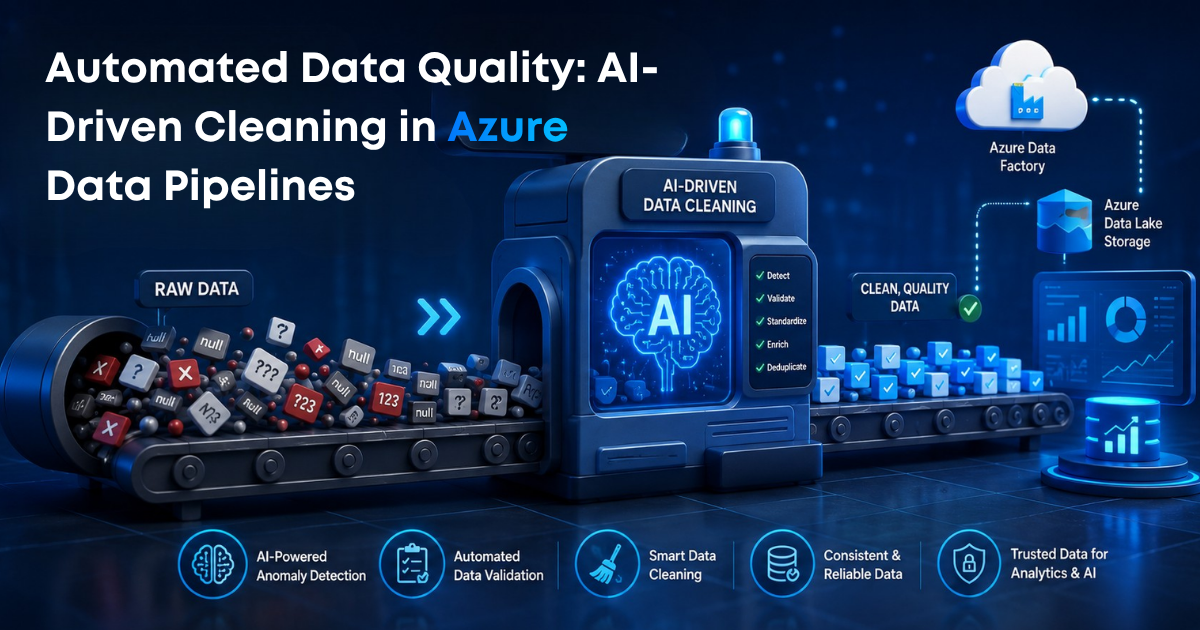
Table Of Content
- The Massive Cost of Dirty Data
- The Evolution of Azure Data Pipelines
- Key AI-Driven Cleaning Techniques
- 1. Machine Learning Pattern Detection
- 2. Probabilistic Deduplication
- 3. Automated Standardization
- Technical Architecture for Automated Quality
- 1. OneLake and the “Medallion” Architecture
- 2. Azure Databricks and Delta Live Tables (DLT)
- 3. Microsoft Purview for Governance
- The Role of Generative AI and Copilots
- Challenges in AI-Driven Data Quality
- Best Practices for Technical Leaders
- Comparison of Cleaning Methods
- Future Trends: Self-Optimizing Pipelines
- Conclusion
Data is the lifeblood of the modern enterprise. However, poor data quality acts like a slow-acting poison. By 2026, the volume of global data is doubling every few years. This explosion makes manual data cleaning impossible. Organizations now turn to Azure Data Analytics to solve this crisis.
In the past, engineers wrote static rules to catch errors. Today, AI-driven cleaning within Azure data pipelines automates this process. It identifies anomalies, fixes inconsistencies, and ensures accuracy without human intervention. This explores the technical framework of automated data quality within Azure Data Analytics Services.
The Massive Cost of Dirty Data
Dirty data is not just a technical nuisance. It is a massive financial burden. In 2026, research shows that poor data quality costs the United States economy roughly $617 billion annually. This represents nearly 2% of the national GDP.
- Organizational Impact: Large enterprises lose an average of $12.9 million per year due to bad data.
- Productivity Loss: Data scientists spend up to 80% of their time cleaning data rather than analyzing it.
- Revenue Decay: Companies lose between 15% and 25% of their potential revenue because of poor data quality.
These stats highlight a critical need. Businesses cannot scale their AI initiatives if their underlying data is broken. Automated quality is the only path forward.
The Evolution of Azure Data Pipelines
Azure has evolved from simple data movement to an intelligent “Data Fabric.” Microsoft Fabric and Azure Data Factory now serve as the core of this transformation.
Traditional pipelines followed a rigid ETL (Extract, Transform, Load) path. If the source data format changed, the pipeline broke. Modern Azure Data Analytics Services use “self-healing” pipelines. These systems use machine learning to adapt to changes in real-time.
Key AI-Driven Cleaning Techniques
AI does not just look for missing values. It understands the context of the information. Here are the primary techniques used in modern Azure pipelines.
1. Machine Learning Pattern Detection
AI models learn what “normal” data looks like by analyzing historical sets. They establish baselines for expected ranges and formats. When a new batch of data arrives, the model flags values that deviate from the norm. This catches “silent” errors that traditional rules might miss.
2. Probabilistic Deduplication
Duplicate records often have slight differences. One record might say “John Doe,” while another says “J. Doe.” AI uses fuzzy logic and probabilistic matching to link these entities. It scores the similarity across multiple attributes to ensure a 99% match accuracy.
3. Automated Standardization
Inconsistent naming conventions ruin reports. AI identifies preferred formats for dates, currencies, and units. It automatically normalizes “USD,” “US Dollars,” and “$” into a single standard. This ensures that downstream Azure Data Analytics models operate on comparable data.
Technical Architecture for Automated Quality
Implementing AI-driven cleaning requires a specific technical stack within the Azure ecosystem.
1. OneLake and the “Medallion” Architecture
Azure uses a “Medallion” structure to manage quality levels:
- Bronze Layer: Stores raw, uncleaned data.
- Silver Layer: Applies AI-driven cleaning and deduplication.
- Gold Layer: Contains business-ready, highly refined data.
This separation ensures that researchers can always access raw data if they need to retrain their AI models.
2. Azure Databricks and Delta Live Tables (DLT)
Databricks plays a vital role in high-speed cleaning. Delta Live Tables use “Expectations” to enforce data quality. You can define a policy that says: “Drop any record where the age is negative.” The AI-optimized Spark engine handles these checks at petabyte scale.
3. Microsoft Purview for Governance
Cleaning data is useless if you cannot track its origin. Microsoft Purview provides end-to-end lineage. It shows exactly which AI model cleaned a specific record. This transparency is essential for regulatory compliance.
The Role of Generative AI and Copilots
In 2026, “Natural Language Data Prep” is a reality. Data engineers no longer write complex Python scripts for every cleaning task. They use Azure Copilot to describe the desired outcome.
- Prompt: “Standardize all country codes to ISO 3166-1 alpha-3 and remove outliers in the transaction column.”
- Action: The Copilot generates the necessary Spark code and inserts it into the pipeline.
- Validation: The AI runs a simulation to show the impact of the cleaning before the user commits the change.
Challenges in AI-Driven Data Quality
Automation is powerful, but it is not perfect. Technical teams must address several risks.
- Algorithmic Bias: If the training data is biased, the cleaning model will be biased. It might “clean away” valid data from minority groups.
- Over-Automation: If the AI is too aggressive, it may delete outliers that are actually important signals for fraud detection.
- Computational Cost: Running AI models on every incoming row of data is expensive. Engineers must balance the depth of cleaning with the budget of their Azure Data Analytics Services.
Best Practices for Technical Leaders
To build a successful automated quality framework, follow these steps:
- Implement Human-in-the-Loop: For high-stakes data, the AI should flag an error but let a human approve the fix.
- Monitor Model Drift: Data patterns change over time. Regularly retrain your cleaning models to stay accurate.
- Start at the Source: The best way to clean data is to prevent it from getting dirty. Use AI-driven validation at the point of data entry.
- Use Version Control: Always treat your cleaning logic as code. Use Git to track changes in your Azure Data Factory pipelines.
Comparison of Cleaning Methods
| Feature | Manual/Rule-Based | AI-Driven Cleaning |
| Setup Time | High (Write every rule) | Medium (Train initial model) |
| Adaptability | Zero (Breaks on schema change) | High (Self-healing) |
| Accuracy | High for known errors | High for unknown anomalies |
| Scalability | Poor | Near-Infinite |
Future Trends: Self-Optimizing Pipelines
The future of Azure Data Analytics lies in fully autonomous data estates. We are moving toward “Zero-Copy” analytics. In this model, the data stays in its original location, and AI agents clean it “on the fly” as it is queried.
By 2027, we expect to see “Self-Healing Metadata.” The system will automatically update its own documentation as the data evolves. This will eliminate the need for manual data catalogs.
Conclusion
Automated data quality is no longer a luxury. It is a survival requirement in the AI era.
- Azure Data Analytics provides the tools to build intelligent, resilient pipelines.
- AI-driven cleaning recovers millions in lost productivity and revenue.
- Medallion architectures ensure a clear path from raw noise to business intelligence.
- Governance tools like Purview ensure that automated changes remain transparent and compliant.
When you invest in Azure Data Analytics Services, focus on the foundation. High-speed processing is useless if the data is wrong. Build your pipelines with “quality by design.” Let the AI handle the drudgery of cleaning. This allows your team to focus on what matters: finding the insights that drive your business forward.



No Comment! Be the first one.