


Building the Composable Enterprise: A Blueprint for MuleSoft Consulting Services
Modern organizations face a massive challenge with IT sprawl. The typical enterprise manages hundreds of disconnected cloud applications, legacy databases, and on-premise systems. When teams build...

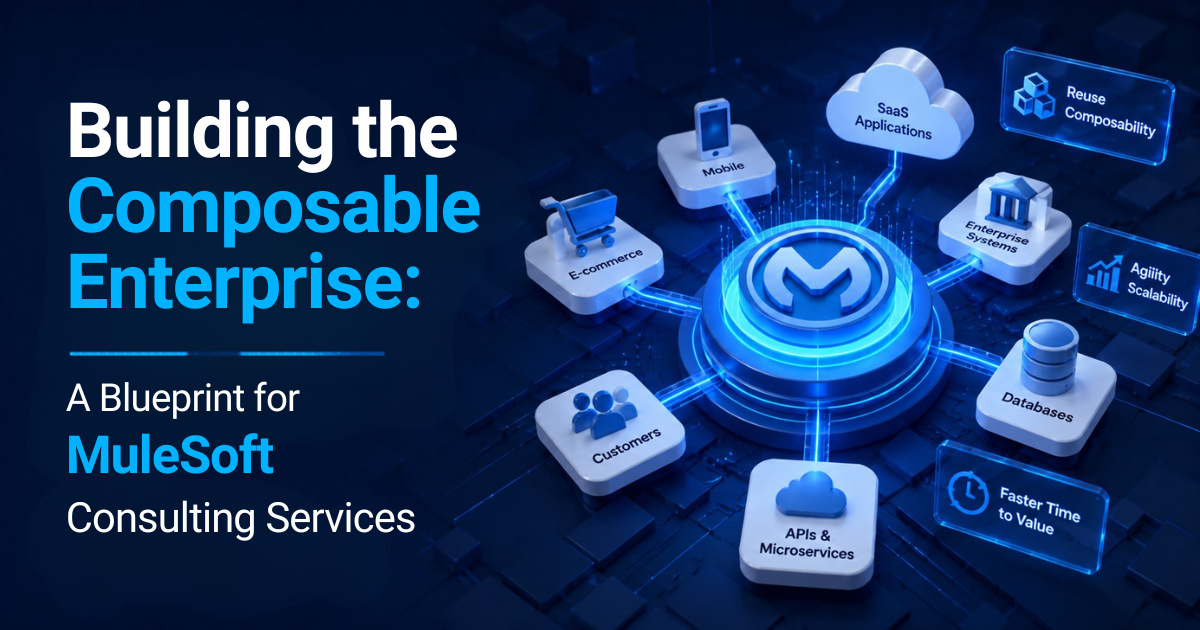
Table Of Content
- What is a Composable Enterprise?
- The Role of Reusable Blocks
- Why Legacy Architectures Fail
- The Core Solution: API-Led Connectivity
- 1. System APIs
- 2. Process APIs
- 3. Experience APIs
- Measurable Value of Composable Architecture
- Proven Integration Statistics
- Financial and Resource Impact
- The Role of MuleSoft Consulting Services
- 1. Architectural Readiness Assessments
- 2. Establishing a Center for Enablement (C4E)
- 3. vCore and CloudHub Optimization
- Modern Integration Drivers
- 1. Connecting AI Agents and LLMs
- 2. Hyperautomation and RPA
- Technical Best Practices for Implementation
- 1. Design APIs First
- 2. Automate Testing and Deployment
- 3. Implement Micro-Gateway Security
- Conclusion
Modern organizations face a massive challenge with IT sprawl. The typical enterprise manages hundreds of disconnected cloud applications, legacy databases, and on-premise systems. When teams build custom code to link these systems, they create rigid architectures. These tightly coupled systems break easily during updates. They slow down business growth.
To survive, forward-thinking businesses change their design strategy. They build a composable enterprise. This model treats every system as a reusable building block. MuleSoft Consulting Services provide the technical framework and expertise to make this structural shift possible.
What is a Composable Enterprise?
A composable enterprise turns business capabilities into independent, reusable data assets. Instead of building monolithic software packages, companies assemble interchangeable parts.
The Role of Reusable Blocks
Think of a composable enterprise like building with modular plastic blocks. If you want to change a workflow, you do not melt the whole model down. You swap out one block for another. For instance, a customer address verification block should work for the e-commerce website, the mobile app, and the retail store terminal at the same time.
Why Legacy Architectures Fail
Traditional integration relies on point-to-point connections. Developers write custom scripts to connect System A directly to System B. This approach functions initially. However, when you connect 20 systems, you create nearly 200 custom code connections. A single modification to one database schema collapses the entire data network.
The Core Solution: API-Led Connectivity
The foundation of any successful MuleSoft Consulting initiative is API-led connectivity. This approach replaces direct system connections with a disciplined, three-tier architecture.
1. System APIs
System APIs connect directly to underlying applications of record. They insulate the rest of the company from the complexities of legacy data structures.
- Function: They format raw database outputs into clean, readable JSON format.
- Benefit: If you change your ERP provider, you only update the System API. The rest of your software stack remains unaffected.
2. Process APIs
Process APIs combine data from multiple System APIs to execute specific business logic. They shape data into functional business processes.
- Function: A process API might pull customer credit records from one system and order history from another. It combines them to generate an automated credit approval score.
- Benefit: Multiple digital channels can reuse this exact process logic without rebuilding the underlying code.
3. Experience APIs
Experience APIs deliver data directly to the end user interface. They format the information to fit specific devices or consumption points.
- Function: They strip out unnecessary data fields to speed up mobile app performance. At the same time, they retain full datasets for desktop web browsers.
- Benefit: Front-end developers build interfaces quickly because they do not have to study back-end business logic.
Measurable Value of Composable Architecture
Moving to a composable model requires a serious investment of time, money, and skilled personnel. However, enterprise statistics prove the value of this financial commitment.
Proven Integration Statistics
Research across enterprise IT departments shows the real-world impact of modular design. According to recent industry surveys, companies utilizing API-led architectures experience a 60% reduction in project delivery times. Furthermore, maintenance costs drop significantly because teams fix bugs inside isolated modules rather than hunting through massive code scripts.
| Operational Metric | Before Composable Shift | After Composable Shift |
| Project Delivery Speed | 3 to 6 Months | 2 to 4 Weeks |
| Code Reusability Rate | Less than 5% | 40% to 60% |
| System Maintenance Overhead | High (Continuous Patches) | Low (Isolated Updates) |
| API Discovery Time | Multiple Days | Under 30 Minutes |
Financial and Resource Impact
When internal teams reuse assets, they save thousands of development hours. The asset repository turns into a self-service market for programmers. This structure prevents redundant work and reduces external labor costs.
The Role of MuleSoft Consulting Services
Deploying the Anypoint Platform requires more than just installing software licenses. Organizations must change their operational culture. Experienced MuleSoft Consulting Services guide companies through this structural transformation.
1. Architectural Readiness Assessments
Consultants analyze your existing infrastructure before writing code. They find performance bottlenecks, security flaws, and redundant data pipelines. This audit sets up a clean roadmap for API migration.
2. Establishing a Center for Enablement (C4E)
A Center for Enablement is a cross-functional group that drives asset reuse across the entire enterprise.
- Asset Governance: The C4E sets design standards for RAML and OAS API specifications.
- Internal Promotion: They train decentralized business units to publish and consume existing building blocks.
- Success Measurement: The team tracks reusability metrics to show clear ROI to company stakeholders.
3. vCore and CloudHub Optimization
Running integrations in the cloud costs money based on computer processing consumption. Expert consultants optimize DataWeave transformations to reduce memory use. This optimization ensures that your CloudHub 2.0 or Runtime Fabric deployments use minimal vCore allocations, keeping cloud bills predictable.
Modern Integration Drivers
The integration world changes constantly. Composable architectures must adapt to handle emerging enterprise technology trends.
1. Connecting AI Agents and LLMs
Enterprise AI requires high-quality, real-time data to operate safely. Large Language Models (LLMs) cannot make smart decisions if they are cut off from internal systems.
MuleSoft provides secure pathways that feed clean transactional data directly into AI prompts. Specialized API gateways control these connections, preventing AI tools from accidentally exposing sensitive internal data.
2. Hyperautomation and RPA
Not every legacy application has an open API. Many old systems rely on user interfaces for data input. Experienced consultants use MuleSoft RPA (Robotic Process Automation) alongside Anypoint Platform to bridge this technical gap. Bots extract data from older computer screens and feed it directly into modern Process APIs.
Technical Best Practices for Implementation
Successful implementations follow strict software engineering disciplines. Avoid shortcuts during the design phase.
1. Design APIs First
Never write code without a blueprint. Use Anypoint Design Center to build API specifications before starting development work. Mock the endpoints to let front-end and back-end teams test their assumptions simultaneously. This step prevents expensive code rewrites later in the project cycle.
2. Automate Testing and Deployment
Incorporate your API development into automated CI/CD pipelines. Use tools like Maven, Jenkins, or GitHub Actions to run MUnit tests automatically with every code change. Require a minimum of 80% code coverage before allowing a developer to push an update to production environments.
3. Implement Micro-Gateway Security
Protect your data edge by deploying MuleSoft Flex Gateway across your containerized networks. This lightweight agent manages API traffic directly near your microservices. It enforces security policies, controls rate limits, and monitors performance without adding noticeable system latency.
Conclusion
Building a composable enterprise is no longer an optional IT experiment. It is a mandatory requirement for modern business survival. Point-to-point programming cannot match the speed of today’s changing markets.By implementing structured API-led connectivity, companies turn their data infrastructure into an agile ecosystem. Partnering with certified MuleSoft Consulting Services speeds up this transition. This collaboration helps you design clean architectures, optimize cloud spending, and build a reusable digital foundation for long-term growth.



No Comment! Be the first one.