


Financing the Field: Custom Agrifintech and Lending Platforms for Farmers
Traditional banking systems frequently fail the agricultural sector. In particular, standard credit underwriting relies heavily on fixed monthly salaries, predictable cash flows, and urban real...

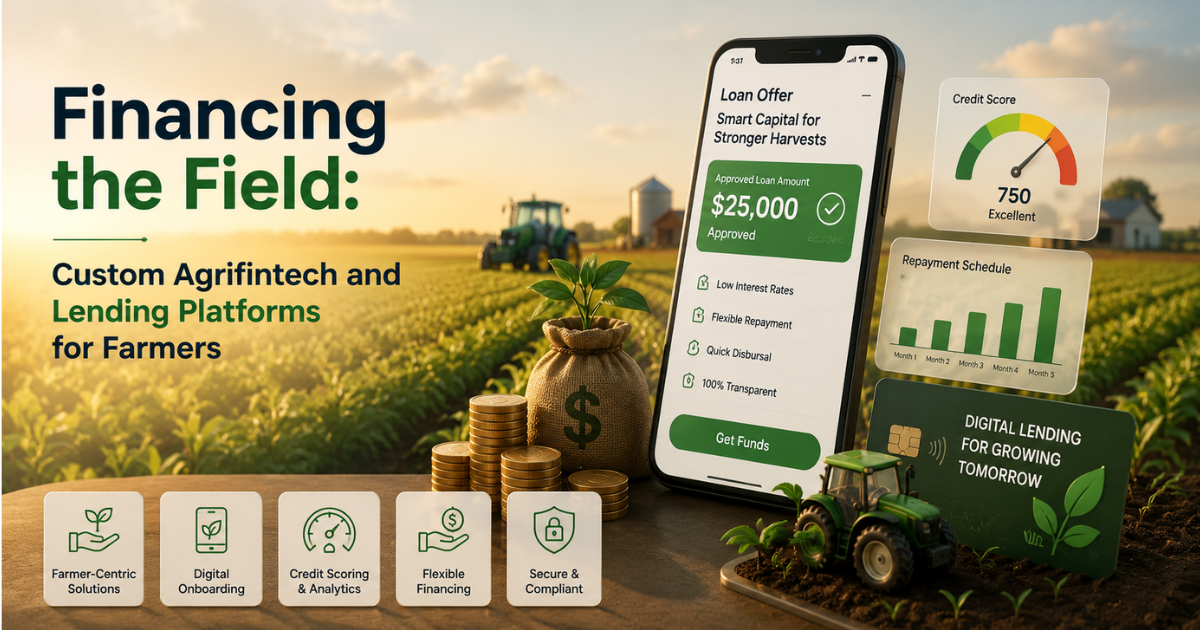
Table Of Content
- The Core Technical Failure of Traditional Agricultural Lending
- 1. The Missing Asset Class
- 2. Ignoring Environmental Realities
- 3. High Transaction Costs
- The Architecture of a Modern Agrifintech Platform
- 1. The Data Ingestion Tier
- 2. The Alternative Underwriting Engine
- 3. The Core Financial Tier
- Technical Comparison: Traditional Banking Software vs. Custom Agrifintech
- Key Modules within Custom Agricultural Lending Platforms
- 1. Satellite-Driven Crop Monitoring Engine
- 2. Structured Warehouse Receipt Financing Module
- 3. Parametric Micro-Insurance Engine
- The Technical Stack for Agrifintech Applications
- 1. Geospatial and Data Processing
- 2. Backend Infrastructure
- 3. Security and Integration
- Case Study: Digital Micro-Lending in Smallholder Networks
- The System Workflow
- Operational Metrics After One Year
- Overcoming Key Implementation Barriers
- 1. Handling the Rural Digital Divide
- 2. Ensuring Strict Data Privacy Compliance
- 3. Mitigating Systemic Climate Risk
- The Future of Embedded Agricultural Finance
- Conclusion
Traditional banking systems frequently fail the agricultural sector. In particular, standard credit underwriting relies heavily on fixed monthly salaries, predictable cash flows, and urban real estate collateral. However, farmers possess none of these conventional financial indicators. This is where Agrifintech platforms create a major difference. Instead, their income arrives in volatile chunks after harvest season. Moreover, their primary assets consist of rural land, heavy machinery, and biological inventory, which Agrifintech solutions can assess more effectively through technology-driven financial models.
Consequently, traditional financial institutions view farming as a high-risk gamble. This dynamic leaves a massive credit gap. The global agricultural loan market sits at approximately $449 billion, yet over 60% of smallholders globally still lack adequate credit support.
The Core Technical Failure of Traditional Agricultural Lending
Traditional loan origination software uses static credit scoring algorithms. These systems evaluate debt-to-income ratios using historical tax returns and consumer credit bureau data. This methodology breaks down entirely when applied to commercial farming.
1. The Missing Asset Class
Traditional banking systems cannot quantify the value of unharvested crops. For instance, a field of premium winter wheat holds clear biological asset value. However, legacy bank databases cannot track a biological asset through its full growth lifecycle. As a result, the crop remains invisible to the bank until the farmer sells it and deposits the cash.
2. Ignoring Environmental Realities
Legacy underwriting software operates in an environmental vacuum. Specifically, it fails to account for regional soil quality, local weather patterns, or access to irrigation systems. As a result, a farmer utilizing precision drip irrigation receives the exact same risk profile as a farmer relying entirely on unpredictable rainfall.
3. High Transaction Costs
Manual field appraisals require bank officers to physically drive out to remote locations. In addition, checking assets across hundreds of acres consumes significant time and operational cost. As a result, for small micro-loans, these overhead expenses often completely eliminate the bank’s potential interest profit.
The Architecture of a Modern Agrifintech Platform
Building a dynamic agricultural credit platform requires specialized Agriculture Software Development Services. These customized platforms break down data barriers. They ingest real-time agronomic data, process it through specialized risk engines, and connect seamlessly with core financial legals.
1. The Data Ingestion Tier
This layer connects directly with the physical world and digital farm management tools. It aggregates data using open Application Programming Interfaces (APIs). Key inputs include:
- Satellite Remote Sensing: First, the platform pulls European Space Agency Sentinel or NASA Landsat imagery to analyze Normalized Difference Vegetation Index (NDVI) data.
- In addition, IoT Field Telemetry: Connected soil probes transmit moisture levels, ambient temperature, and nitrogen-phosphorus-potassium (NPK) metrics via cellular networks or LoRaWAN.
- Finally, Enterprise Resource Planning (ERP) Data: The system extracts historic yield volumes, seed purchase invoices, and chemical applications directly from farm management software.
2. The Alternative Underwriting Engine
The core processing layer translates raw agronomic indicators into financial risk scores. Machine learning algorithms compare real-time crop health indices against ten years of regional climate history. The software estimates final crop yields within a 5% margin of error three months before harvest.
3. The Core Financial Tier
Once the engine approves a loan, this tier automates money movement. It manages customer onboarding through automated Know Your Customer (KYC) and Anti-Money Laundering (AML) microservices. It connects to banking networks to distribute funds and manage payment collections.
Technical Comparison: Traditional Banking Software vs. Custom Agrifintech
The following table contrasts legacy lending architectures with modern, customized agricultural lending platforms.
| Operational Feature | Traditional Banking Portals | Custom Agrifintech Platforms |
| Primary Underwriting Data | FICO scores, historical tax documents | NDVI data, soil metrics, historical yields |
| Collateral Evaluation | Urban real estate, liquid cash reserves | Biological inventory, grain warehouse receipts |
| Risk Monitoring | Annual manual financial review | Real-time satellite crop health tracking |
| Loan Disbursal Speed | 4 to 6 weeks | 24 to 48 hours |
| Data Ingestion Model | Manual upload of PDF documents | Automated REST APIs, MQTT IoT streams |
| Loan Repayment Structure | Rigid monthly fixed installments | Flexible, harvest-aligned custom timelines |
Key Modules within Custom Agricultural Lending Platforms
An enterprise agricultural credit application contains specialized functional blocks. Therefore, software development teams design and build these modules to specifically target agricultural financing structures.
1. Satellite-Driven Crop Monitoring Engine
This module continuously monitors the collateral throughout the life of the loan. Specifically, the system runs cron jobs every five days to download fresh satellite passes over a farmer’s exact GPS coordinates.
[Fetch Sentinel-2 Satellite Bands] —> [Calculate NDVI Matrix] —> [Flag Variations Against Regional Norms]
The system calculates the NDVI matrix using specific light bands:
$$NDVI = \frac{NIR – Red}{NIR + Red}$$
If the NDVI calculation flags a sudden plunge in crop health, the software immediately triggers an automated alert. Subsequently, the risk engine flags potential pest outbreaks or drought damage in real time. As a result, this allows lenders to adapt loan terms or intervene early to reduce financial risk.
2. Structured Warehouse Receipt Financing Module
Farmers often face terrible market prices if they sell immediately after harvest. However, warehouse receipt financing helps solve this issue effectively. When a farmer deposits grain into a certified silo, the silo operator immediately issues a digital receipt containing weight, moisture, and quality metrics.
Next, the agrifintech platform ingests this receipt through an API link connected to the smart silo network. Then, the system calculates the real-time cash value of the grain based on live commodity exchange pricing. As a result, it automatically opens a revolving line of credit worth up to 70% of the total cash value within minutes.
3. Parametric Micro-Insurance Engine
Traditional insurance requires claims adjusters to inspect crop damage manually. As a result, this process often delays payments by months. In contrast, custom agrifintech platforms utilize parametric triggers to automate payouts efficiently.
For example, the platform continuously monitors local weather station APIs or satellite radar data. Then, if regional rainfall drops below a specific millimeter threshold for twenty consecutive days, the policy triggers automatically. Consequently, the system executes a payout via electronic funds transfer without requiring any manual claim form.
The Technical Stack for Agrifintech Applications
Building secure, scalable agrifintech applications requires enterprise-grade backend infrastructure. The software must handle heavy geospatial datasets while maintaining strict banking security protocols.
1. Geospatial and Data Processing
- Python with GeoPandas and Rasterio is essential for processing heavy satellite imagery, vector maps, and raster data files. In addition, it enables efficient geospatial analysis at scale.
- Similarly, PostGIS, an extension for the PostgreSQL database, allows the system to run complex geographic database queries on farm boundary lines. As a result, spatial relationships and land records can be analyzed more accurately and efficiently.
2. Backend Infrastructure
- Java Spring Boot or .NET Core: These compiled frameworks provide the necessary security, transactional integrity, and stability required for banking operations.
- Apache Kafka: Manages real-time data streams from thousands of active IoT soil sensors and weather monitors simultaneously.
3. Security and Integration
- OAuth 2.0 & OIDC: First, these protocols secure internal microservices and manage user access rights across mobile and web interfaces. As a result, the system ensures safe authentication and controlled authorization.
- In addition, Plaid / Open Banking APIs connect the custom agrifintech software securely to external commercial bank accounts. Consequently, this enables instant identity verification and seamless money transfers within the platform.
Case Study: Digital Micro-Lending in Smallholder Networks
An agricultural input supplier in Southeast Asia wanted to provide credit directly to 50,000 corn smallholders. However, these farmers lacked formal bank accounts and standard land titles. As a result, the supplier required an automated system to assess risk without increasing operational overhead costs.
The company engaged an expert team for custom Agriculture Software Development. The developers built a mobile-first agrifintech platform optimized for low-bandwidth cellular environments.
[Farmer Mobile App] —> [Upload GPS Field Points & Identity] —> [AI Underwriting Engine Checks Satellites] —> [Mobile Wallet Loan Disbursal]
The System Workflow
- First, the farmer drops digital pins on a mobile map interface to outline their field boundaries.
- Next, the platform’s backend reads five years of historical satellite data for those exact coordinates to evaluate historical productivity.
- After that, the AI underwriting engine analyzes the data and approves a customized credit limit within three minutes.
- Finally, the system delivers the loan value as digital credit vouchers directly to the farmer’s mobile wallet.
Operational Metrics After One Year
- Loan Approvals: Total processing time dropped from twenty days to four minutes.
- Portfolio Health: The platform maintained a low loan default rate of 2.1%, beating the regional retail bank average of 4.5%.
- Yield Improvement: Access to high-quality seed and fertilizer financing boosted average farmer crop yields by 24%.
Overcoming Key Implementation Barriers
Deploying agrifintech applications introduces distinct structural and environmental hurdles. Development teams must build workarounds into their initial software blueprints.
1. Handling the Rural Digital Divide
Many agricultural heartlands suffer from poor cellular internet connectivity. Developers must build mobile applications with offline-first capabilities. The software should store transactional data locally in an encrypted SQLite database. The app syncs data back to central cloud servers once the phone finds a reliable network signal.
2. Ensuring Strict Data Privacy Compliance
Farmers are highly protective of their proprietary yield and location data. Agrifintech platforms must secure this data using Advanced Encryption Standard (AES) 256-bit protocols. The platform user interface must feature explicit consent screens before pulling data from third-party Agri-Stacks or government registries.
3. Mitigating Systemic Climate Risk
A massive regional drought can damage thousands of insured farms simultaneously, risking platform liquidity. Engineers protect platforms by building automated portfolio diversification algorithms into the lender dashboard. The software prevents over-concentration of capital in single crop types or vulnerable geographical zones.
The Future of Embedded Agricultural Finance
The era of separating farm management from financial management is coming to an end. In fact, the industry is moving rapidly toward embedded finance architectures. As a result, farmers will no longer need to visit a bank branch or open a separate loan portal.
Instead, financial tools will exist inside their primary farm machinery dashboards and agronomy apps. When a tractor detects a faulty part, the onboard system will order a replacement and secure equipment financing simultaneously.
Enterprise agrifintech software turns abstract field data into tangible financial trust. By substituting rigid paper trails with dynamic data streams, these systems create a more resilient food supply chain. Embracing specialized Agriculture Software Development Services allows financial innovators to build these platforms today, securing high-yield portfolios while funding the future of global food production.
Conclusion
Custom agrifintech platforms are reshaping how capital flows into global food production. By replacing rigid, manual credit metrics with real-time agronomic data and satellite imagery, these systems effectively eliminate the traditional barriers to rural credit. As a result, they provide financial institutions with the clarity needed to accurately assess risk, minimize defaults, and deploy capital more efficiently.
Moreover, for agribusinesses and lenders looking to scale, off-the-shelf software cannot fully replicate the nuances of regional crop cycles and complex supply chains. Therefore, partnering with a dedicated Agriculture Software Development Company ensures your lending platform is secure, interoperable, and built for the unique demands of the field. Ultimately, embracing a data-driven, automated approach to agricultural finance builds a more resilient and well-funded farm ecosystem capable of meeting future global demands.



No Comment! Be the first one.