Revenue is climbing. New customers are signing on. The hiring plan is expanding, and at least two investors have asked for a follow-up meeting. On the surface, everything looks like it is working. Then the founder checks the bank balance and wonders how a business generating this much revenue can feel this tight on cash.
This is one of the most common and most disorienting experiences for UAE startup founders approaching their first serious growth phase. Many of them have already started exploring outsourced CFO services in Dubai, not because the business is failing, but because they have realized that scaling is not primarily a sales challenge. It is a financial control challenge. And the gap between those two things is where promising startups quietly run into serious trouble.
The Scaling Myth Nobody Warns You About
There is a belief that sits at the back of most founders’ minds: if revenue is growing, everything else will sort itself out. It is an understandable assumption. Revenue feels like proof. It validates the product, the team, the market fit. But revenue and financial health are not the same thing, and confusing the two is an expensive mistake.
Fast-growing startups run out of money all the time not because the business model is broken, but because growth consumes cash faster than most founders anticipate. Customers who pay on 60-day terms create a receivables gap. Payroll expands before revenue catches up. Marketing spend increases to sustain momentum. Overheads accumulate in ways that only become visible months later.
The warning signs are usually there before the crisis arrives. Constant cash shortages despite strong sales. Expenses that seem to appear from nowhere. Revenue forecasts that keep missing. An inability to clearly explain the business’s financial performance to a potential investor without a lot of hedging. If any of those sound familiar, the problem is not the numbers.it is the absence of financial leadership to interpret and manage them.
The Financial Challenges That Show Up Earlier Than Expected
Growth does not simplify a startup’s finances. It complicates them, often faster than the team can adapt.
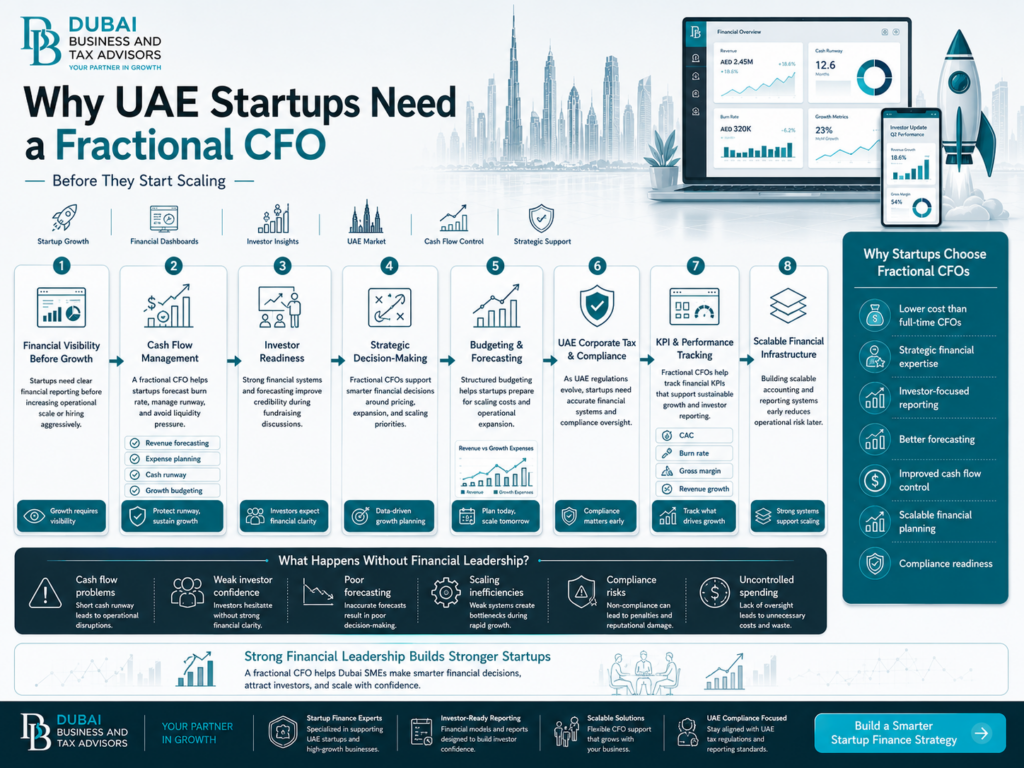
Cash flow is the first thing that becomes genuinely difficult. Managing receivables, controlling expenses, maintaining enough working capital to operate, and forecasting future cash needs these are separate disciplines that all demand attention simultaneously. Most early-stage founders manage this intuitively for a while. At scale, intuition is not enough.
Hiring decisions compound the problem. Every new team member is a financial commitment that extends months into the future, regardless of what happens to revenue. Compensation planning, resource allocation, and workforce sustainability require a level of financial modelling that goes well beyond a spreadsheet.
Expansion into new markets or product lines adds another layer entirely of additional overhead, increased compliance obligations under UAE Corporate Tax regulations, and operational complexity that has a direct financial cost. Each of these challenges is manageable with the right financial infrastructure. Without it, they tend to arrive together, and they are much harder to resolve under pressure.
Too Much Data, Not Enough Clarity
Most founders scaling a startup are not short of financial information. They have dashboards, reports, and metrics coming from multiple directions. The problem is that data and insight are very different things.
A revenue dashboard tells you what happened. It does not tell you why margins are compressing, whether the current burn rate is sustainable for the next eight months, or what the cash position will look like if a major client delays payment by 45 days. Reporting is not interpretation. Information is not a strategy.
This is the gap that financial leadership fills and it is a gap that accountants, no matter how competent, are not typically positioned to fill. Accounting records history. Strategic financial leadership shapes future decisions.
The Metrics Every Founder Should Understand Before Scaling
Before a startup grows aggressively, its founder needs to understand a handful of numbers with genuine clarity not just what they are, but what they mean for the business.
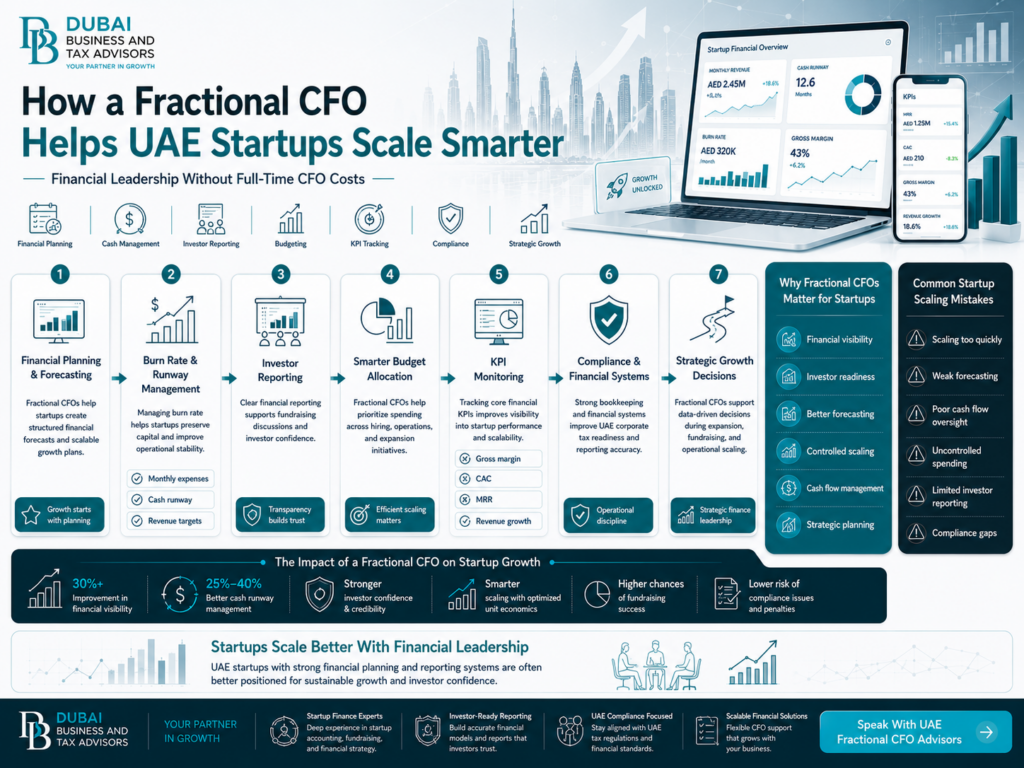
Burn rate tells you how quickly the company is spending its reserves. Runway tells you how long it can sustain current operations before needing fresh capital. Gross margin reveals whether the core business model is actually profitable at the unit level, independent of revenue volume. Many founders overestimate this figure significantly.
Customer Acquisition Cost (CAC) and Customer Lifetime Value (LTV) together answer the most fundamental growth efficiency question: is the business spending money wisely to acquire customers who generate sustainable returns? A startup growing rapidly with a poor LTV-to-CAC ratio is essentially accelerating toward a problem, not away from one.
Revenue growth rate needs context to be meaningful. Growth of 30% looks very different depending on the margin profile, the market size, and the burn rate behind it. EBITDA strips out financing and accounting decisions to show operational performance more clearly.
Investors understand these metrics fluently. Founders who cannot speak to them confidently during a funding conversation signal something they probably do not intend to signal.
What Scaling Without Financial Leadership Actually Costs?
Growth has a tendency to magnify whatever already exists in a business. Strong systems scale well. Weak ones fracture under pressure.
A startup with loose financial reporting, no formal forecasting process, and limited internal controls can function reasonably well at early stages because the founder can hold most of the financial picture in their head. As the business grows, that stops working. The volume of transactions increases. The complexity of decisions increases. The cost of each mistake increases.
Over-hiring is one of the most common and expensive outcomes. A team expands based on optimistic revenue projections that do not materialize on schedule, and the payroll commitment remains regardless. Overestimating revenue and underestimating expenses separately, both are manageable. Together, during a growth phase, they create a cash crisis that can be very difficult to reverse quickly.
Poor cash management during scaling has ended businesses that were, by every surface measure, succeeding. Revenue on paper means nothing if the cash is not there to meet obligations.
What a Fractional CFO Actually Does?
The title creates some confusion, so it is worth being direct about what a fractional CFO brings that an accountant or bookkeeper does not.
Accounting functions record what has already happened transaction management, compliance, tax filings, financial statements. All essential. None of it is strategic. A CFO function looks forward. It builds financial models, runs scenario analyses, creates forecasting frameworks, monitors performance against targets, and translates financial data into decisions the founder can actually act on.
A fractional CFO delivers this at a senior level without the cost or commitment of a full-time executive hire. For a startup that needs strategic financial leadership but is not yet at the stage where a full-time CFO salary makes sense, this is a practical and often highly effective structure.
The work includes building cash flow forecasting models that give founders genuine visibility weeks and months ahead, not just a snapshot of yesterday. It includes structuring financial reporting so that the right people see the right information at the right time. It includes preparing the business for investor conversations by ensuring the financial narrative is coherent, credible, and well-supported.
Why Investors Care So Much About Financial Clarity?
Founders sometimes assume that investors primarily evaluate the product or the market opportunity. Those matter, but financial transparency matters just as much often more during due diligence.
Investors ask very specific questions. How much runway remains? What assumptions underpin the revenue forecast? What is the unit economics story? How does profitability change under different growth scenarios? These are not hostile questions. They are the natural concerns of someone considering committing capital to a business they cannot fully control.
Weak financial reporting does not just create friction during due diligence it raises credibility questions that are very difficult to walk back. A startup that cannot produce a clean, well-structured financial forecast signals operational immaturity regardless of how strong the product is. Valuation discussions are directly affected by the quality of financial governance a business can demonstrate.
Startups that arrive at fundraising conversations with solid financial systems, clear metrics, and a coherent growth model close rounds faster and on better terms. That outcome does not happen by accident.
The Financial Systems Worth Building Before You Scale
Getting these foundations right before growth accelerates is substantially easier than retrofitting them under pressure.
A proper revenue forecasting framework, one that models different growth scenarios rather than assuming a single trajectory gives founders and investors a much more honest picture of where the business is headed. Expense forecasting, paired with a budget management process that creates real discipline around spending decisions, prevents the quiet cost creep that tends to catch growing startups off guard.
KPI monitoring systems that track the metrics that actually matter, not vanity metrics, but the numbers connected to sustainable growth give founders an early warning system rather than a rear-view mirror. Financial reporting structures that create genuine visibility, combined with basic internal controls that reduce the risk of errors or misuse, form the backbone of a scalable financial operation.
None of this requires a full finance department. It requires the right expertise applied at the right stage.
The UAE Context Makes This More Urgent, Not Less
Corporate Tax in the UAE has materially changed the financial obligations facing startups. Documentation requirements, financial recordkeeping standards, and tax planning considerations that were once optional best practices are now compliance necessities. A startup that has been operating informally needs to restructure its financial records before growth creates an even larger backlog.
Regulatory obligations become more complex as a business grows more transactions, more employees, more reporting requirements. Building financial governance during growth is significantly harder than building it before growth. The businesses that approach scaling with these systems already in place spend their energy on growth. The ones that do not spend their energy on catch-up.
Founder Burnout Is a Financial Risk
This part often goes unsaid. Founders managing sales, operations, hiring, and finance simultaneously are not doing any of those things as well as they could. Financial decision fatigue is real delayed decisions, missed signals, increased risk tolerance born from exhaustion rather than confidence.
Strategic financial support does not just improve the numbers. It gives founders their focus back. Knowing that someone with genuine senior financial expertise is monitoring cash position, flagging risks, and preparing the business for its next funding conversation changes how a founder operates day to day.
When Is the Right Time?
Earlier than most founders think. The clearest signals are growth accelerating faster than financial systems can track, cash flow becoming unpredictable, investors starting to ask questions the founder cannot answer cleanly, and financial reports becoming difficult to interpret without significant manual effort.
Key milestones that consistently trigger the need include preparing for a funding round, expanding into new markets, growing headcount beyond a certain threshold, and increasing revenue complexity through new products or customer segments.
A full-time CFO makes sense eventually but for most early-to-mid-stage UAE startups, that hire is premature and expensive. This is precisely why many founders are turning to outsourced CFO services in Dubai as a structured alternative: access to senior financial expertise, without the fixed cost of a full-time executive, with the flexibility to scale the engagement as the business grows.
Frequently Asked Questions
What exactly does a Fractional CFO do that an accountant does not?
An accountant keeps your records accurate and your filings compliant both essential, but backward-looking by nature. A fractional CFO looks forward. They build financial models, forecast cash flow, stress-test growth assumptions, and help founders make major decisions hiring, expansion, and fundraising with full financial visibility. Think of accounting as the scoreboard and a fractional CFO as the coach designing the next play.
At what revenue stage does a UAE startup actually need a Fractional CFO?
There is no universal revenue threshold, but the trigger is usually complexity rather than size. Once a startup is managing payroll for a growing team, dealing with VAT and Corporate Tax obligations, preparing for investor conversations, or finding that cash flow has become genuinely unpredictable, financial leadership adds immediate value. Many founders wait too long precisely because things still look fine on the surface.
How does a Fractional CFO help a startup prepare for a funding round?
Investors expect more than a revenue chart. They want clean financial records, credible forecasts built on documented assumptions, clear unit economics, and a founder who can answer detailed financial questions without hesitation. A fractional CFO builds the models, structures the narrative, and ensures the business can withstand due diligence without surprises derailing the process at a critical moment.
Does UAE Corporate Tax make a Fractional CFO more necessary for startups?
Significantly. Corporate Tax has introduced documentation standards, recordkeeping obligations, and tax planning considerations that many early-stage startups are not structured to handle properly. A fractional CFO ensures the financial infrastructure meets regulatory expectations while also positioning the business to manage its tax position intelligently as it grows rather than scrambling to catch up when compliance becomes urgent.
Is a Fractional CFO a short-term fix or a long-term strategic resource?
It depends entirely on where the business is heading. Some startups engage a fractional CFO to solve a specific problem preparing for fundraising, restructuring financial reporting, or navigating a period of rapid growth. Others maintain the relationship on an ongoing basis as a core part of their financial leadership structure, scaling the engagement up or down as needs change. The flexibility is precisely what makes the model work for startups that are not yet ready for a full-time executive hire.
Conclusion
Growth creates complexity. That part is inevitable. What is not inevitable is being caught off guard by it. Revenue growth alone does not guarantee financial stability, and startups that learn this lesson during a crisis pay a much higher price than those who build financial leadership from the start.
Dubai Business & Tax Advisors works with UAE startups to build exactly that foundation: cash flow forecasting, investor-ready reporting, Corporate Tax planning, and financial systems that give founders real visibility before scaling exposes the gaps.
The best time to strengthen financial leadership is before growth creates the pressure. That conversation starts with Dubai Business & Tax Advisors.