





Agentforce B2B Agents: Powerful Strategies for More Conversions
The B2B sales cycle requires precision and speed. Traditional lead qualification and pipeline management consume excessive manual labor. According to data from the Salesforce State of Sales Report,...

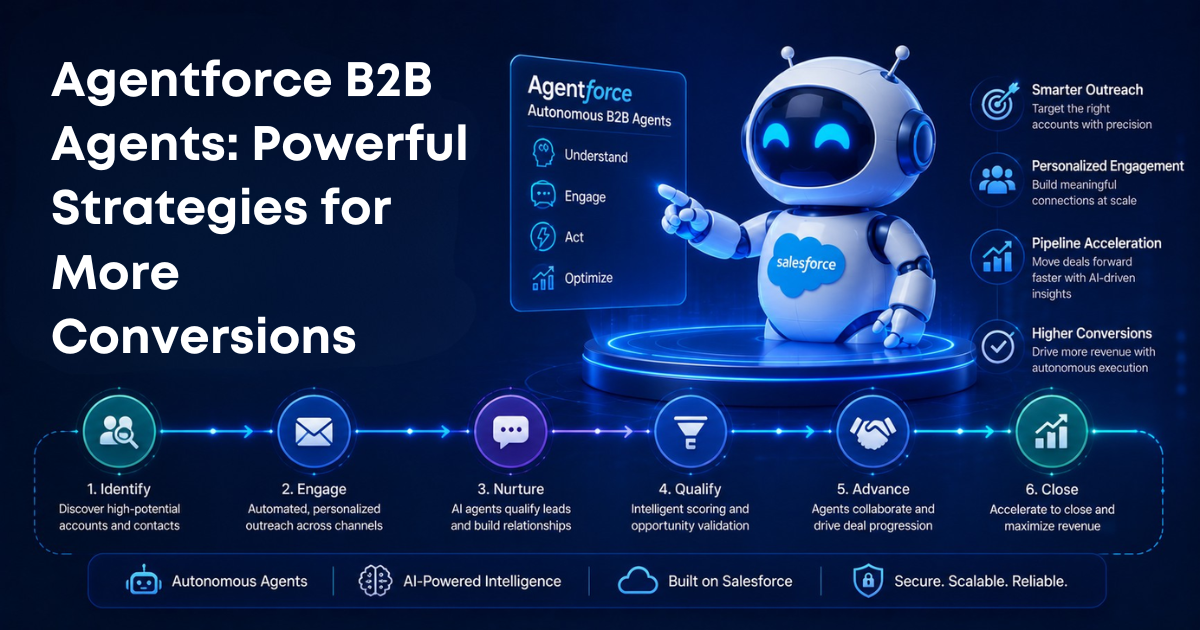
Table Of Content
- Technical Foundations of Agentforce
- 1. The Role of Salesforce Data Cloud
- 2. The Atlas Reasoning Engine
- Architecture of a B2B Sales Agent
- 1. Topics and Scope Definition
- 2. Instructions and Behavioral Rules
- 3. Actions and System Integration
- 4. Guardrails and the Einstein Trust Layer
- Step-by-Step Implementation via Agentforce Services
- 1. Planning the Agent Scope
- 2. Configuring Data Ingestion
- 3. Creating the Agent in Agentforce Studio
- 4. Assigning Topics and Actions
- 5. Authoring Instructions
- 6. Testing and Debugging
- Use Case: The Autonomous Inbound Sales Agent
- Quantifiable Impact on B2B Pipelines
- 1. Conversion and Productivity Rates
- 2. Deal Velocity
- 3. Operational Volume
- Technical Challenges and Mitigation Strategies
- 1. Managing Fragmented Data
- 2. Accuracy and Alignment Optimization
- The Evolving Role of Human Sales Teams
- Conclusion
The B2B sales cycle requires precision and speed. Traditional lead qualification and pipeline management consume excessive manual labor. According to data from the Salesforce State of Sales Report, sales representatives spend up to 71% of their time on administrative tasks and non-selling activities. This manual overhead slows down lead response times and causes potential deals to drop out of the sales pipeline.
Salesforce introduced Agentforce to address these execution gaps. Unlike traditional rule-based chatbots, Agentforce utilizes autonomous artificial intelligence agents that can reason, plan, and execute tasks within the customer relationship management (CRM) ecosystem. This examines the technical architecture, development workflows, and implementation strategies required to build autonomous B2B sales agents using Salesforce Agentforce Development frameworks.
Technical Foundations of Agentforce
Autonomous agents require an integrated environment to function reliably. Agentforce does not operate as an isolated software layer. It integrates directly with the Salesforce core platform, utilizing existing security permissions, sharing rules, and automated workflows.
1. The Role of Salesforce Data Cloud
Autonomous agents require accurate, real-time data to prevent hallucinations and incorrect responses. Salesforce Agentforce Development Services rely on Salesforce Data Cloud as the single source of truth. Data Cloud unifies fragmented data from separate enterprise systems. These systems include:
- Enterprise Resource Planning (ERP) platforms
- Product usage data repositories
- Web analytics tools
- Legacy databases via Zero Copy ingestion
Data Cloud processes unstructured data, such as contract text and email correspondence, alongside structured metrics. In recent enterprise deployments, companies processed up to 18 terabytes of unstructured data to supply context to their active artificial intelligence models. This unified context allows an agent to understand the historical relationship between a prospect and the enterprise before initiating outreach.
2. The Atlas Reasoning Engine
The operational core of Agentforce is the Atlas Reasoning Engine. This engine processes user requests by evaluating available data, generating an execution plan, and selecting the correct action tools. The reasoning engine follows a continuous loop:
This structural cycle ensures that the agent checks company data and system security rules before executing an automation. The engine continually refines its actions based on the specific parameters of the active B2B sales cycle.
Architecture of a B2B Sales Agent
Building a B2B sales agent requires configuring four primary components within the Salesforce platform: topics, instructions, actions, and guardrails.
1. Topics and Scope Definition
Topics define the precise operational boundaries of an autonomous agent. For a B2B pipeline generation agent, developers configure separate topics for lead classification, product inquiry management, and meeting scheduling. Defining clear topics prevents the agent from processing irrelevant customer requests or straying from its intended sales function.
2. Instructions and Behavioral Rules
Instructions are natural language directives that guide the decision-making process of the reasoning engine. Instructions define how the agent should handle objections, phrase product benefits, and prioritize specific industries. Programmers write instructions to enforce corporate communication policies and maintain a consistent tone across automated channels.
3. Actions and System Integration
Actions are the tools that allow an autonomous agent to execute programmatic changes. Instead of relying on manual code for every interaction, Agentforce utilizes existing Salesforce investments. Agents can invoke:
- Salesforce Flows: To update opportunity stages, modify lead scores, or assign tasks.
- Apex Classes: To perform complex programmatic calculations or query specific data records.
- MuleSoft APIs: To pull real-time pricing data or verify credit terms from external ERP architectures.
According to Salesforce product performance reports, enterprises have built over 4 trillion flows. Agentforce utilizes these pre-built automations to execute back-end tasks without requiring engineers to write new integration code.
4. Guardrails and the Einstein Trust Layer
Enterprise B2B operations require strict data governance. The Einstein Trust Layer protects proprietary corporate data during agent operations. This security layer masks personally identifiable information (PII) before routing data to external large language models. It also prevents external models from using corporate CRM data for public training purposes.
Step-by-Step Implementation via Agentforce Services
Deploying an autonomous sales agent involves structured configuration phases within Agentforce Studio. The process translates business logic into technical parameters that the reasoning engine can execute.
1. Planning the Agent Scope
Developers must first map out the ideal customer profile parameters and the explicit data fields needed for qualification. This phase identifies the specific CRM fields, such as annual revenue, geographic location, and software stack compatibility, that the agent must analyze.
2. Configuring Data Ingestion
Engineers connect Data Cloud to the necessary data streams. If data lives outside of Salesforce, developers implement Zero Copy links. This approach allows the agent to read external system metrics without creating duplicate data records.
3. Creating the Agent in Agentforce Studio
Admins open Agentforce Studio to define the new agent record. They assign the agent a digital persona and configure its primary language models.
4. Assigning Topics and Actions
The technical team adds relevant topics to the agent profile. For an inbound sales agent, developers attach a flow action named Qualify_Inbound_Lead and an Apex action named Check_Rep_Calendar_Availability.
5. Authoring Instructions
Developers write precise behavioral instructions within the studio interface. For example:
“If the prospect asks about enterprise pricing, check their company size in Data Cloud. If employees exceed 1,000, trigger the Enterprise_Quote flow instead of providing standard tier pricing.”
6. Testing and Debugging
Developers use the built-in simulation console to test agent responses against sample inputs. The console displays the specific reasoning path, showing which topics were activated and which actions were triggered.
Use Case: The Autonomous Inbound Sales Agent
Consider a global B2B software provider experiencing high inbound lead volumes. Manual response times previously averaged four hours, allowing competitors to engage prospects first. The company utilized Salesforce Agentforce Development Services to deploy an autonomous inbound sales agent.
The agent monitors incoming web forms and digital channels continuously. When a prospect submits an inquiry, the agent coordinates several tasks immediately:
| Phase | Technical Action | System Involved |
| Ingestion | Reads incoming form submission data. | Sales Cloud |
| Enrichment | Matches email domain against corporate records. | Data Cloud |
| Verification | Pulls firmographic data to confirm company size. | External API via MuleSoft |
| Evaluation | Assesses intent signals based on technical documentation downloads. | Einstein Lead Scoring |
If the prospect fits the ideal customer profile, the agent drafts a personalized response. This message addresses specific product questions by retrieving information from the internal Salesforce Knowledge Base.
The agent then sends a scheduling link, allowing the prospect to select an open time slot on a human representative’s calendar. IBM Institute for Business Value research indicates that deploying agentic artificial intelligence in sales and customer service applications can reduce response times from hours to under three minutes.
Quantifiable Impact on B2B Pipelines
Deploying autonomous agents directly alters the metrics of the sales pipeline. Organizations moving away from old, manual workflows report clear operational improvements.
1. Conversion and Productivity Rates
Data from enterprise implementations shows that optimizing Salesforce with Agentforce can yield a 26% average increase in lead-to-opportunity conversion rates. Autonomous agents handle the repetitive filtering steps that typically slow down human staff. This shift allows account executives to dedicate their time to active deals, resulting in a 34% gain in overall sales team productivity.
2. Deal Velocity
In B2B sales, long cycles increase the risk of deal cancellation. Salesforce benchmark data shows that integrating agentic artificial intelligence across the sales cycle compresses timelines, delivering a 28% improvement in overall deal velocity. Agents ensure that follow-ups occur within minutes of a prospect signal, preventing leads from becoming cold.
3. Operational Volume
Autonomous agents run continuously without interruption. During internal operations, Salesforce utilized its own Agentforce tools to handle over 2.8 million automated interactions. The system contacted 130,000 previously unaddressed leads within four months, creating 3,200 qualified opportunities without increasing employee headcount.
Technical Challenges and Mitigation Strategies
While the advantages of autonomous agents are substantial, enterprise engineering teams must navigate specific technical challenges during deployment.
1. Managing Fragmented Data
Fragmented enterprise data remains a significant barrier to artificial intelligence success. According to the State of Salesforce Report by IBM, 74% of Salesforce customers struggle to improve engagement metrics because key customer data remains trapped in isolated external legacy silos. Agents operating without access to these silos cannot accurately evaluate customer context.
Mitigation Strategy: Technical teams must prioritize Data Cloud configuration before building agent logic. Connecting legacy systems via MuleSoft or Zero Copy integrations ensures the agent has access to historical billing, support, and product usage records.
2. Accuracy and Alignment Optimization
A primary concern for B2B executives is the risk of false signals or inaccurate commitments made by autonomous systems. In unauthorized or poorly structured environments, agents can misinterpret complex buying signals, leading to high false-positive rates in pipeline staging.
Mitigation Strategy: Implement strict validation parameters using the Einstein Trust Layer. Developers should create narrow topics and use specific, closed-ended instructions. According to system deployment tracking, simple agents operating with well-defined topics achieve up to 95% execution accuracy. In contrast, unconstrained custom builds often plateau at 50% to 60% accuracy.
The Evolving Role of Human Sales Teams
The deployment of autonomous software agents does not remove human professionals from the sales cycle. Instead, it changes their daily operational focus.
When autonomous agents manage data entry, lead logging, and initial outreach, human representatives can concentrate on high-value negotiation. Human agents step in when a prospect requires tailored contract customizations, security reviews, or deep relationship management.
Furthermore, sales professionals are learning to manage these digital assistants. Salesforce data indicates that 82% of sales representatives believe that mastering artificial intelligence tools improves their long-term career advancement opportunities. Representatives move into strategic roles where they refine agent instructions, analyze pipeline trends, and manage complex enterprise accounts.
Conclusion
Autonomous B2B agents represent a fundamental shift in pipeline generation. By combining the data unification power of Data Cloud with the execution capabilities of the Atlas Reasoning Engine, enterprises can automate complex sales workflows safely.Successful deployment requires a methodical, data-first approach. Companies must clean their CRM records, unify external data streams, and build precise instructions within Agentforce Studio. Organizations that invest in proper Salesforce Agentforce Development can eliminate administrative bottlenecks, improve deal velocity, and build a scalable, always-on sales pipeline.



No Comment! Be the first one.