




How Laparoscopy Can Help Treat Fibroids and Ovarian Cysts
If you have been told you have uterine fibroids or ovarian cysts, you probably have a list of questions. What are they exactly? Do they need surgery? And what is this “laparoscopy” everyone mentions?...

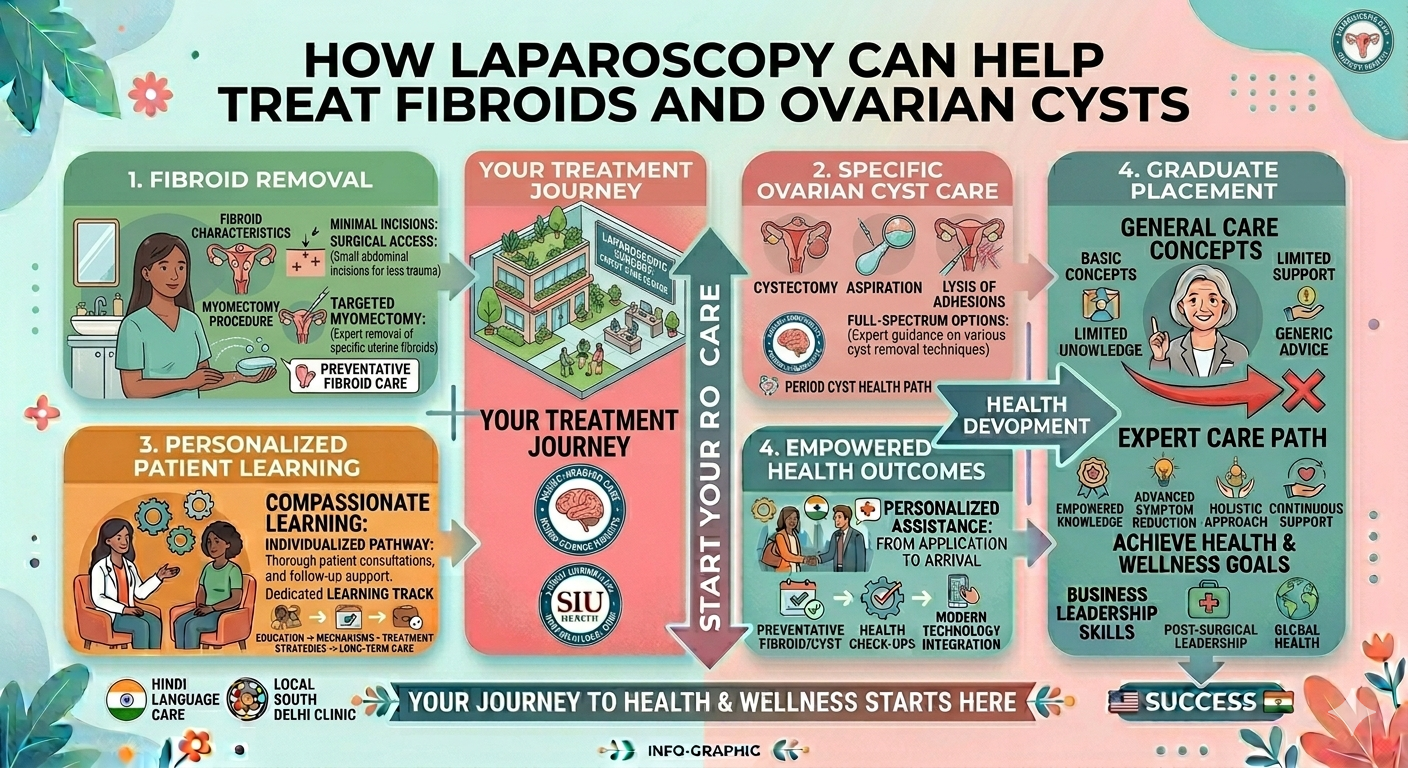
Table Of Content
If you have been told you have uterine fibroids or ovarian cysts, you probably have a list of questions. What are they exactly? Do they need surgery? And what is this “laparoscopy” everyone mentions?
Let me explain it the way I would to a student or a friend who wants clear, no‑fear answers. No medical jargon overload. Just what works, why it works, and what you should know before making a decision.
First, What Are Fibroids and Ovarian Cysts?
Fibroids are non‑cancerous growths in the muscle wall of the uterus. They can be as small as a pea or as large as a melon. Many women have them and never know. But when fibroids cause heavy bleeding, pelvic pressure, frequent urination, or pain during intercourse, they need attention.
Ovarian cysts are fluid‑filled sacs that develop on or inside an ovary. Most are harmless and disappear on their own within a few cycles. However, some cysts grow large, twist the ovary (a painful emergency), or rupture and cause internal bleeding. Others, like endometriomas, are linked to endometriosis and do not resolve without treatment.
When Is Surgery Actually Needed?
Not every fibroid or cyst requires surgery. A gynecologist will usually suggest monitoring if you have no symptoms. But surgery becomes necessary when:
- Pain interferes with daily life
- Bleeding causes severe anemia
- The cyst or fibroid grows rapidly
- There is suspicion of cancer (rare, but possible)
You are planning pregnancy and the growth blocks the fallopian tubes or distorts the uterus
Once surgery is on the table, the big question is: open surgery or laparoscopy?
What Makes Laparoscopy Different
Open surgery means a single large incision across your lower abdomen, like a caesarean scar. Recovery takes six to eight weeks, and hospital stay is several days.
Laparoscopy is minimally invasive. The surgeon makes three to four tiny cuts – each about half an inch long. Through one cut, a camera (laparoscope) goes in. Through the others, thin instruments remove the fibroid or cyst. The whole procedure is done while you watch the camera view on a screen.
Here is the part women appreciate most: most laparoscopic surgeries are same‑day or next‑day discharge. You go home with small bandages, not a large wound. Pain is less. Scarring is minimal. And you are back to normal activities in two to three weeks, not two months.
How Fibroids Are Removed Laparoscopically
For fibroids, the procedure is called laparoscopic myomectomy. The surgeon removes only the fibroids and leaves the healthy uterine muscle intact. That is crucial if you want children later.
Not all fibroids qualify for laparoscopy. Size matters. A single fibroid up to 8‑10 cm can often be removed this way. But multiple large fibroids or very deep ones may still need open surgery. A good surgeon will not force laparoscopy if it is unsafe – they will tell you honestly.
How Ovarian Cysts Are Treated
For cysts, laparoscopy is usually the first choice. The surgeon makes a small cut in the cyst, drains the fluid, and removes the sac wall. If the ovary is severely damaged or the cyst is suspicious for cancer, the whole ovary may be removed (oophorectomy). But for benign cysts like dermoids or endometriomas, the ovary is preserved.
One common worry: “Will removing a cyst affect my fertility?” No, not if the healthy ovarian tissue is left behind. In fact, removing a large cyst often improves fertility by restoring normal anatomy.
What to Expect Before and After
Before surgery, you will have an ultrasound or MRI to map the growth. You will be asked to stop eating after midnight. The surgery itself takes 30 minutes to two hours, depending on complexity.
Afterwards, you may feel shoulder tip pain – a weird but harmless effect of the gas used to inflate your abdomen. It passes in a day or two. You can shower within 48 hours but should avoid heavy lifting and intercourse for two to four weeks.
Most women tell me the worst part is the waiting before surgery. The actual recovery is easier than they feared.
When to Seek Expert Guidance
Laparoscopy is a skill‑based surgery. The outcome depends heavily on who performs it. A surgeon who does hundreds of these procedures each year will have fewer complications – less bleeding, less chance of injury to bowel or bladder, and lower risk of the cyst or fibroid coming back.
If you live in or around Delhi, you have access to excellent care. Many women ask me where to start. I usually tell them to look for a Best Gynecologist in South Delhi who specializes in minimally invasive surgery. Not every gynecologist performs laparoscopy routinely. You want someone who offers it as a primary option, not an afterthought.
Similarly, if you already have a diagnosis of fibroids or a complex cyst, it is wise to a Gynecologist in South Delhi who can review your scans and tell you honestly: “Yes, laparoscopy is right for you” or “You need a different approach.” A second opinion never hurts.
The Bottom Line
Laparoscopy has transformed how we treat fibroids and ovarian cysts. It turns what used to be a major surgery into a minor one, with less pain, shorter recovery, and excellent results. But it is not magic. It works best for the right patient with the right surgeon.
Do your homework. Ask questions. Get a surgeon who listens and explains. And remember – most fibroids and cysts are benign. Even when they cause trouble, modern medicine has gentle, effective ways to help you feel like yourself again.
read blog ecomotion.ae.



No Comment! Be the first one.