How Salesforce Commerce Cloud Development Services Drive Measurable Revenue Growth

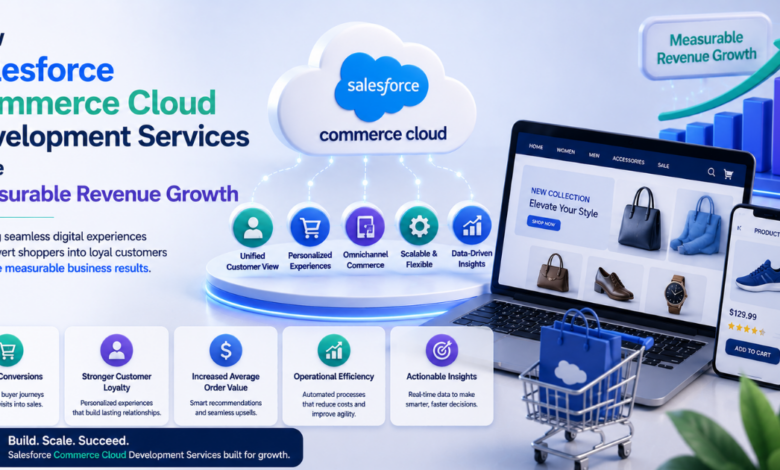
Online shopping now moves at a scale few platforms can handle without failure. During Cyber Week 2025, global online sales hit $336.6 billion, up 7% year over year. Salesforce alone powered 61 million orders through Agentforce Commerce with 100% uptime. Numbers like these show why Salesforce Commerce Cloud Development Services have become a direct revenue lever, not just a technical upgrade.
Commerce Platforms Now Decide Revenue Outcomes
A storefront that slows down during peak traffic loses sales every second it lags. A checkout flow with too many steps loses customers before they finish buying. Revenue growth today depends on technical execution as much as marketing spend.
Salesforce tracked shopping behavior across more than 1.5 billion shoppers during Cyber Week 2025. The data showed AI and agent-driven tools influenced 20% of all purchases, worth $67 billion in sales. Retailers running their own branded shopping agents saw sales grow 32% faster than competitors without them.
These figures point to one conclusion. The technical depth of a commerce platform directly shapes revenue performance, especially during high-traffic periods.
What Salesforce Commerce Cloud Actually Delivers
Salesforce Commerce Cloud supports both B2C and B2B selling models on one platform. It handles product catalogs, pricing rules, promotions, checkout, and order management within a single system.
Key technical components include:
- PWA Kit: A framework for building fast, headless storefronts using React.
- Page Designer: A drag-and-drop tool for building landing pages without custom code for every change.
- Agentforce Commerce: AI agents that handle product search, recommendations, and customer questions.
- Order Management: Tracks inventory, fulfillment, and returns across channels.
- Einstein Recommendations: Suggests products based on real-time shopper behavior.
These tools give a strong starting point, but raw features rarely translate into revenue without skilled configuration. This is exactly where Salesforce Commerce Cloud Development comes into play.
Why Revenue Growth Depends on Development, Not Just Licensing
Buying a Commerce Cloud license does not guarantee higher sales. The platform needs custom configuration that matches a brand’s catalog structure, customer base, and sales channels.
A development team builds the layer between Commerce Cloud’s core features and a business’s actual revenue goals. Without this work, businesses often use only a fraction of what the platform offers.
Common reasons businesses invest in Salesforce Commerce Cloud Development Services include:
- Need for custom storefront design that matches brand identity.
- Integration requirements with ERP, CRM, and payment systems.
- Performance demands during seasonal traffic spikes.
- Migration projects moving off legacy commerce platforms.
- AI feature setup for personalized product recommendations.
Core Development Practices That Drive Revenue
A few specific development practices consistently show up in commerce projects that produce strong revenue results.
1. Performance Optimization for Peak Traffic
Page load speed has a direct, measurable link to conversion rates. Slow pages cause shoppers to abandon their carts before checkout. Development teams optimize image loading, caching, and server response times to keep pages fast under heavy load.
Salesforce’s own Cyber Week data backs this up. The platform handled 61 million orders with full uptime during the highest-traffic week of the year. That kind of reliability comes from deliberate technical planning, not luck.
2. AI-Powered Personalization
Generic product listings convert at lower rates than personalized ones. Development teams configure Einstein Recommendations and Agentforce Commerce to show shoppers products based on browsing history and purchase patterns.
Digital retailers using AI and agentic features during the 2025 holiday season saw conversion rates rise by 5% compared to retailers without these tools. That gap adds up fast across millions of transactions.
3. Headless and Composable Storefronts
PWA Kit lets developers build storefronts separate from the backend commerce engine. This approach, often called headless commerce, gives brands more design flexibility and faster page performance. Faster pages keep shoppers engaged longer and reduce bounce rates.
4. Checkout Flow Optimization
Every extra step in checkout risks losing a customer. Development teams reduce friction by enabling one-click payments, guest checkout, and mobile wallet support. Mobile wallet usage, including tools like Apple Pay, grew 31% year over year during the 2025 holiday season. Storefronts without this option miss a fast-growing payment preference.
5. System Integration
A commerce platform rarely works alone. Development teams connect Commerce Cloud to ERP systems for inventory accuracy, CRM platforms for customer data, and shipping providers for fulfillment updates. Poor integration creates stock errors and shipping delays that hurt customer trust and repeat purchases.
Real-World Example from Peak Shopping Season
Consider how agentic commerce performed during Cyber Week 2025. Retailers using their own branded AI shopping agents saw sales grow 32% faster than retailers without one. The number of tasks completed by these agents rose 70% compared to the prior year.
This shift did not happen by accident. Development teams configured these agents to answer product questions, suggest items, and guide shoppers through checkout. The technical setup behind these agents turned a customer service feature into a direct revenue driver.
Social commerce showed a similar pattern. Social media referral traffic to commerce sites grew 15% year over year, with TikTok’s share growing 86% year over year within that category. Development teams that build clean integrations between social platforms and Commerce Cloud capture this traffic instead of losing it to broken links or slow landing pages.
Measurable Revenue Metrics to Track
Strong Salesforce Commerce Cloud Development Services should produce results that show up in tracked business metrics, not just technical reports.
- Conversion rate: Percentage of visitors completing a purchase, often improved through personalization and checkout optimization.
- Average order value: Often increased through smart product bundling and recommendation placement.
- Page load time: Directly tied to bounce rate and cart abandonment.
- Mobile payment adoption: Tracks how well a storefront captures fast-growing payment preferences.
- Return rate: Salesforce found shoppers returned about 13% of online purchases made between November 1 and December 15, 2025, making clear product pages and sizing guides a real revenue factor.
Tracking these metrics over time shows whether development investment actually moves the needle on revenue, not just on technical performance scores.
How Development Services Support Each Revenue Lever
A capable Salesforce Commerce Cloud Development team builds revenue improvements into the platform at a technical level, rather than relying on marketing alone to close the gap.
- Catalog and pricing logic: Custom rules for promotions, bundles, and tiered pricing that match business strategy.
- A/B testing setup: Technical infrastructure to test page layouts, pricing displays, and checkout flows.
- API development: Custom endpoints that connect Commerce Cloud to internal tools or third-party services.
- Mobile-first design: Responsive storefronts built for the growing share of mobile shopping traffic.
- Agent configuration: Setup and tuning of AI shopping agents for product discovery and support.
Each of these pieces connects back to a measurable business outcome, whether that’s a higher conversion rate, larger basket size, or stronger repeat purchase rate.
Choosing the Right Development Partner
Not every development team brings the same depth of Commerce Cloud experience. A few factors separate strong partners from weak ones.
Look for a Salesforce Commerce Cloud Development Services partner that offers:
- Certified developers with hands-on Commerce Cloud project history.
- Performance testing experience, especially for high-traffic events like holiday sales.
- Integration expertise across ERP, payment, and fulfillment systems.
- A clear approach to AI feature configuration, since Agentforce Commerce setup requires careful tuning.
- Post-launch support, since commerce platforms need ongoing optimization after go-live.
Ask for case studies tied to a similar business size and industry. A team experienced with small boutique brands may struggle with the scale a national retailer needs during peak shopping weeks.
Common Mistakes That Limit Revenue Growth
Even strong platforms underperform when development work skips key steps. Watch for these mistakes:
- Launching without load testing for expected peak traffic.
- Ignoring mobile checkout speed in favor of desktop design only.
- Skipping AI personalization setup due to time pressure.
- Building point-to-point integrations instead of scalable API connections.
- Treating launch as a finish line instead of an ongoing optimization process.
A development partner with retail experience flags these risks early, before they cost real revenue during a live shopping event.
The Future of Commerce Cloud Development
Agentic commerce is moving from experiment to mainstream adoption fast. Agents already influenced 22% of projected Cyber Week orders in 2025, and that share is likely to keep climbing. Conversational shopping experiences, AI-driven product discovery, and automated customer support now sit at the center of commerce strategy.
Expect these trends to shape future Commerce Cloud projects:
- Wider adoption of branded AI shopping agents across mid-size retailers, not just large enterprises.
- Deeper integration between social platforms and commerce storefronts.
- Continued growth in mobile wallet and one-click payment adoption.
- Expanded use of predictive analytics to forecast demand and reduce returns.
Businesses that invest in flexible, well-built Commerce Cloud foundations now will adapt faster as these shifts continue.
Final Thoughts
Revenue growth in online retail now depends on technical execution as much as product quality or marketing spend. Salesforce Commerce Cloud gives businesses a strong platform, but configuration quality decides whether that platform actually drives sales.
Businesses that pair the platform with experienced Salesforce Commerce Cloud Development Services see the difference in real numbers: higher conversion rates, faster page performance, and stronger results during the highest-stakes shopping moments of the year.