How Mobile Automation is Solving Operational Challenges for Modern Businesses

Operational efficiency has become a critical business priority as organizations manage increasingly complex workflows, distributed workforces, and rising customer expectations. At the same time, businesses must process larger volumes of data while making decisions faster than ever before.
The shift toward mobile-first operations reflects this reality. According to StatCounter, Android continues to hold more than 70% of the global mobile operating system market, making mobile applications a central component of enterprise technology strategies. Industry research from Gartner also shows that digital workplace investments remain a top priority for organizations seeking to improve workforce productivity and operational visibility.
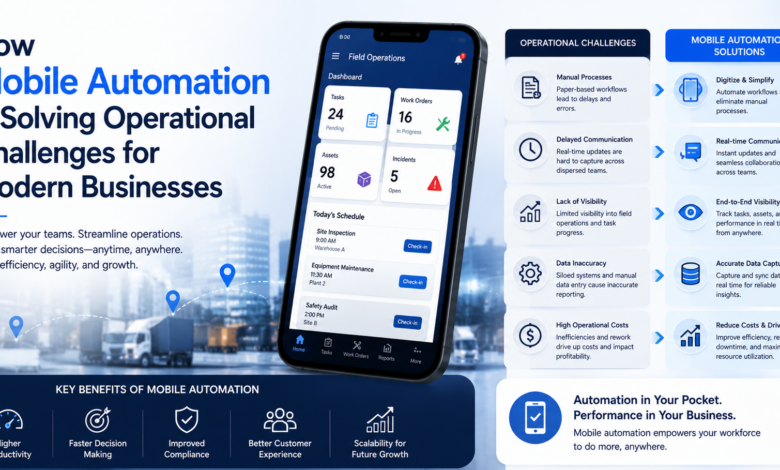
Despite advances in enterprise software, many businesses still rely on manual processes, fragmented communication channels, and disconnected systems. These challenges often result in delayed decisions, inconsistent data, and reduced operational efficiency. Mobile automation addresses these issues by connecting employees, business applications, and workflows through mobile devices, enabling organizations to manage operations more effectively while maintaining greater visibility across business functions.
Why Operational Complexity Continues to Increase
Modern businesses operate within highly connected environments where information flows across multiple departments, locations, and systems.
A single business process may involve customer relationship management platforms, enterprise resource planning systems, inventory databases, communication tools, and reporting applications. While these technologies support operations, they can also create complexity when they function independently.
As organizations expand, several operational challenges become more pronounced:
- Delays in information sharing
- Duplicate data entry
- Limited visibility into ongoing activities
- Inconsistent reporting
- Increased administrative workload
- Difficulty coordinating distributed teams
These challenges affect organizations across industries, including manufacturing, logistics, healthcare, retail, and field service operations.
The issue is rarely the lack of technology. More often, businesses struggle because employees must navigate multiple systems to complete routine tasks.
The Operational Cost of Manual Workflows
Manual processes remain a significant obstacle to efficiency.
Many organizations continue to depend on spreadsheets, email approvals, paper-based documentation, and manual reporting methods. While these approaches may function adequately at smaller scales, they often become difficult to manage as business operations grow.
Manual workflows introduce several risks.
Data accuracy becomes harder to maintain when employees enter the same information into multiple systems. Reporting delays occur because information requires manual collection and consolidation. Managers often make decisions based on outdated information rather than current operational conditions.
The financial impact can be substantial. Administrative tasks consume valuable employee time, while delayed responses can affect customer satisfaction, service quality, and operational performance.
Mobile automation helps reduce these inefficiencies by digitizing and automating routine business activities directly through mobile applications.
How Mobile Automation Improves Operational Performance
Mobile automation enables organizations to execute business processes through mobile devices while automating repetitive tasks behind the scenes.
Rather than relying on manual intervention for every step, predefined workflows manage actions such as notifications, approvals, status updates, and data synchronization.
The result is a more connected operational environment where information moves faster and requires fewer manual touchpoints.
Real-Time Access to Business Information
One of the most significant advantages of mobile automation is immediate access to operational data.
Employees no longer need to return to office workstations to update records or retrieve information. Mobile applications allow users to access critical business data directly from their devices.
This capability supports faster decision-making across several operational areas:
- Inventory management
- Field service operations
- Asset monitoring
- Customer support
- Delivery management
- Production oversight
Real-time visibility reduces delays and improves responsiveness throughout the organization.
Improved Workforce Productivity
Mobile automation reduces the administrative burden placed on employees.
Instead of spending time entering data repeatedly or completing manual reporting processes, employees can focus on higher-value responsibilities.
For example, field technicians can update service records directly from job sites. Sales representatives can access customer information during client meetings. Logistics personnel can update shipment statuses without relying on manual communication chains.
Productivity improvements often result from removing unnecessary process steps rather than increasing employee workload.
Greater Consistency Across Operations
Consistency becomes increasingly important as organizations scale.
Manual processes frequently vary between teams, locations, or departments. These variations can create reporting discrepancies and operational inefficiencies.
Mobile automation supports standardized workflows that ensure employees follow consistent procedures regardless of location.
This consistency improves data quality while making operational performance easier to measure and manage.
Industry Applications of Mobile Automation
The benefits of mobile automation extend across multiple industries.
Manufacturing
Manufacturers use mobile automation to support equipment inspections, maintenance activities, production monitoring, and quality control processes.
Employees can record operational data directly from production environments while automated systems distribute information to relevant stakeholders.
Logistics and Transportation
Logistics organizations depend on accurate and timely information.
Mobile automation supports shipment tracking, route management, proof-of-delivery documentation, and fleet operations. Real-time updates improve visibility across supply chains and help organizations respond more effectively to disruptions.
Healthcare
Healthcare providers use mobile applications to improve communication, manage operational workflows, and support clinical teams with faster access to information.
Automation reduces administrative complexity while supporting compliance and operational efficiency.
Field Service Organizations
Field service operations often involve distributed workforces operating across multiple locations.
Mobile automation enables technicians to receive assignments, access service histories, document work performed, and complete reporting tasks directly from mobile devices.
Enterprise Example: Coca-Cola’s Mobile Workforce Initiatives
Large enterprises have already demonstrated the value of mobile-enabled operations.
Coca-Cola bottling operations have implemented mobile technologies to support field sales teams and improve access to customer information. By providing mobile access to inventory data, product catalogs, customer records, and ordering systems, field representatives can perform critical business activities without depending on office-based processes.
The initiative improved operational responsiveness while reducing delays associated with manual workflows. It also provided employees with faster access to business information, enabling more efficient customer interactions.
This example illustrates how mobile automation supports operational performance beyond simple task digitization.
Why Custom Mobile Applications Matter
While off-the-shelf applications can address common business requirements, many organizations operate with processes that require greater flexibility.
Businesses often need applications that integrate with existing systems, support specialized workflows, and align with industry-specific requirements.
This need has increased demand for custom mobile development solutions.
Organizations frequently work with an experienced Android app development company to create applications that support operational objectives rather than forcing teams to adapt to generic software limitations.
Custom solutions can integrate with:
- ERP systems
- CRM platforms
- Inventory management software
- IoT platforms
- Asset management systems
- Business intelligence tools
As operational requirements become more complex, professional Android app development Services help organizations build scalable mobile solutions that support long-term business goals.
Measuring ROI from Mobile Automation
The value of mobile automation extends beyond technology implementation.
Organizations typically evaluate success through measurable operational outcomes.
Common improvements include:
Faster Process Execution
Automated workflows reduce delays associated with approvals, reporting, and task management.
Improved Data Accuracy
Real-time data capture reduces manual entry errors and improves reporting reliability.
Lower Administrative Costs
Organizations often reduce the time employees spend on repetitive administrative activities.
Better Customer Service
Faster access to information enables more responsive customer interactions and issue resolution.
Increased Operational Visibility
Managers gain greater insight into ongoing activities, helping them identify issues and make informed decisions more quickly.
These benefits contribute to stronger operational performance and more efficient resource utilization.
The Future of Mobile Automation
The role of mobile automation will continue to expand as businesses adopt cloud computing, artificial intelligence, and connected technologies.
Future mobile applications will increasingly support:
- Predictive maintenance
- Intelligent workflow recommendations
- Advanced analytics
- IoT-enabled monitoring
- Automated decision support
Organizations that establish strong mobile foundations today will be better positioned to integrate these technologies into future operations.
Final Thoughts
Operational challenges often arise from disconnected systems, manual processes, and limited visibility rather than a lack of technology. As organizations grow, these issues become more difficult to manage and can directly affect productivity, customer experience, and business performance.
Mobile automation addresses these challenges by connecting employees, workflows, and business systems through real-time mobile applications. By reducing administrative effort, improving access to information, and supporting consistent processes, mobile automation helps businesses operate more efficiently in increasingly complex environments.
For organizations seeking long-term operational improvements, partnering with an experienced Android app development company and investing in specialized Android app development Services can provide the technical foundation needed to support scalability, efficiency, and future growth.