




Maximizing Data Cloud: The Technical Core of Modern Salesforce Marketing Services
Modern corporate marketing requires a complete shift in how companies handle customer data. Fragmented data architectures prevent real-time personalization at scale. Historically, companies isolated...

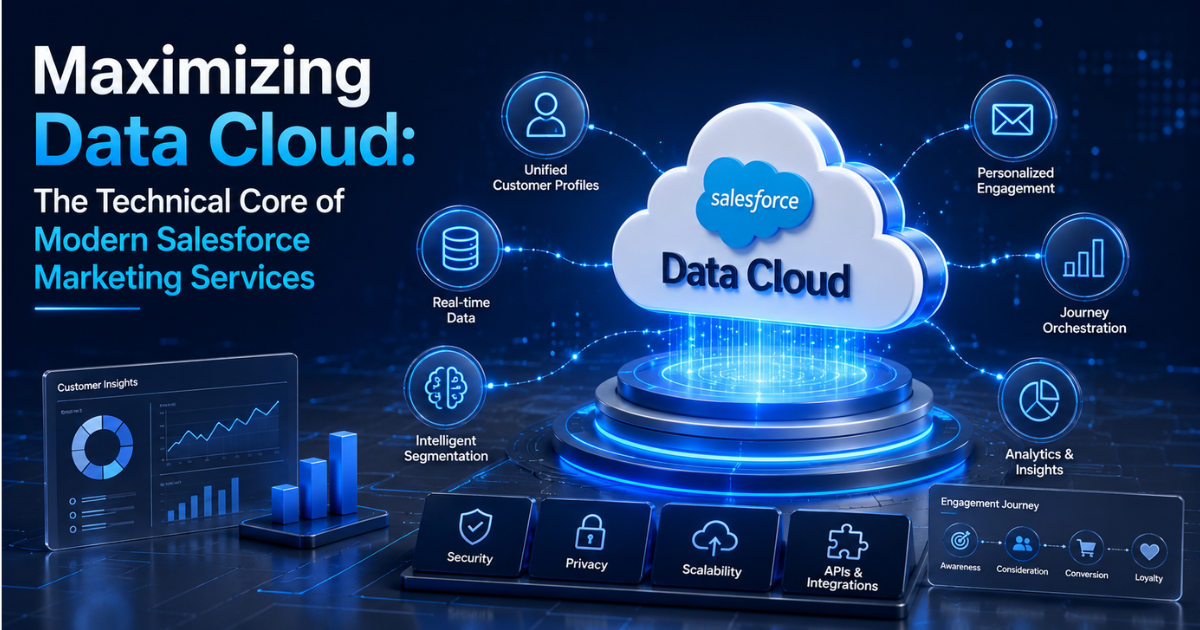
Table Of Content
- Technical Architecture of Data Cloud Integration
- 1. Ingestion Engines and Inbound Data Pipelines
- 2. The Zero-Copy Data Architecture
- Data Harmonization and the Customer 360 Schema
- 1. Data Lake Objects to Data Model Objects Mapping
- 2. Identity Resolution and Reconciliation Rules
- Advanced Segmentation and Activation Mechanics
- 1. Query Engines and Segment Building
- 2. Waterfall Segmentation Logic
- 3. Activation Targets and Data Extension Generation
- Real-Time Automation with Data Actions
- 1. Complex Event Processing
- 2. Core Flow and API Activations
- Enterprise Integration Patterns
- 1. Single-Org Marketing Cloud Connect
- 2. The Limits of Legacy Multi-Org Connectors
- 3. Data Cloud One as the Modern Alternative
- Security, Privacy, and Data Governance
- 1. Data Spaces for Granular Isolation
- 2. Consent Management and Cryptographic Protocols
- Maximizing Project ROI and Implementation Success
- 1. Audit Underlying Data Hygiene
- 2. Choose Incremental Refresh Paths
- 3. Work with Certified Architects
- Conclusion
Modern corporate marketing requires a complete shift in how companies handle customer data. Fragmented data architectures prevent real-time personalization at scale. Historically, companies isolated operational databases from communication tools. This isolation caused high latency and fragmented messaging.
Recent industry statistics demonstrate the scale of this problem. Salesforce reported that its Data Cloud engine surpassed 50 trillion operational records. This milestone positions the platform as a massive enterprise data layer.
Additionally, combined Data Cloud and AI annual recurring revenue grew 120% year-over-year. This rapid growth shows that global enterprises now treat data centralization as an urgent requirement.
To achieve maximum value, companies look to specialized Salesforce Marketing Cloud Services. These services bridge enterprise data lakes with operational execution systems. This article details the underlying mechanics, data models, and architectural integration patterns. These technical tools power the modern Salesforce Marketing Cloud ecosystem.
Technical Architecture of Data Cloud Integration
Data Cloud operates as a high-scale lakehouse infrastructure built directly on Hyperforce. It separates computing power from storage resources. This design lets companies process petabytes of incoming data without slowing down operational CRM functions.
1. Ingestion Engines and Inbound Data Pipelines
The engine collects data using multiple ingestion methods. It utilizes native streaming APIs to capture real-time clickstream events from mobile apps and web platforms.
For batch loading, Data Cloud uses secure cloud storage buckets or native connectors. These tools import data directly from external data warehouses like Snowflake, Google BigQuery, and Databricks.
2. The Zero-Copy Data Architecture
Traditional integration patterns require complex Extract, Transform, Load (ETL) data pipelines. These pipelines physically copy data across platforms, which increases storage costs and security risks.
Modern Salesforce Marketing Cloud Services implement zero-copy data federation instead. This framework creates a metadata-driven connection to cloud data warehouses.
Data Cloud reads external tables using open storage standards like Apache Iceberg and Parquet. The platform queries information directly from its original storage location. This approach eliminates data duplication while keeping processing latency under a few milliseconds.
Data Harmonization and the Customer 360 Schema
Ingesting raw data is only the initial step. Raw inputs feature different naming conventions, primary keys, and formatting styles. Data Cloud harmonizes these inputs using the standard Customer 360 Data Model.
1. Data Lake Objects to Data Model Objects Mapping
When data enters the system, the platform writes the raw records into Data Lake Objects (DLOs). These DLOs maintain the exact schema of the originating external system.
Engineers then map these DLOs to standard Data Model Objects (DMOs). The DMO layer utilizes a unified global schema containing hundreds of pre-built business entities.
2. Identity Resolution and Reconciliation Rules
A single customer often interacts with a brand across multiple distinct systems. They might use an ecommerce account, a marketing newsletter email, and a service ticket. This creates multiple separate records for one individual.
Data Cloud resolves these differences using advanced identity resolution rules. Architects create matching rules based on exact criteria, such as hashed email addresses. They also use fuzzy matching criteria, such as matching phone numbers with minor variations.
Reconciliation rules determine which system provides the most accurate data for the master profile. For instance, the system can prioritize physical addresses from the ERP over older marketing web forms.
Advanced Segmentation and Activation Mechanics
Harmonized data must flow back into execution platforms to drive real value. Data Cloud creates distinct segments and pushes them directly into messaging tools.
1. Query Engines and Segment Building
The system evaluates complex audience criteria using high-performance query engines. Marketers build segments via natural language tools using Einstein Segment AI. They can also use drag-and-drop rule visualizers.
The underlying engine converts these logical selections into optimized SQL queries. These queries scan through billions of unified rows instantly.
2. Waterfall Segmentation Logic
Modern deployments utilize waterfall segmentation to control message frequency. This logic prioritizes audiences sequentially down a defined path.
- Segment 1 (VIP Buyers): Receives premium loyalty offers.
- Segment 2 (Recent Leads): Automatically excludes any members already captured in Segment 1.
- Segment 3 (Win-Back Contacts): Excludes members from both Segment 1 and Segment 2.
This strict ordering prevents message fatigue. It ensures customers receive only the most relevant operational message.
3. Activation Targets and Data Extension Generation
Once a segment resolves, the platform publishes it to a designated Activation Target. When targeting the Salesforce Marketing Cloud, this activation generates a Shared Data Extension.
Engineers select up to 20 related relational attributes to include with the audience file. These attributes can include recent loyalty tiers or calculated lifetime values. Journey Builder uses these fields to personalize automated messages in real time.
Real-Time Automation with Data Actions
Traditional segmentation patterns rely on batch schedules that refresh every few hours. Data Cloud solves this delay through streaming data actions.
1. Complex Event Processing
Streaming data actions monitor incoming events continuously. The engine evaluates behavioral triggers, such as a mobile app user abandoning a digital cart. If the event matches predefined criteria, the platform triggers a data action instantly.
[Web Clickstream Event] —> [Real-Time Streaming Insight] —> [Immediate Data Action API Call] —> [Journey Builder Launch]
2. Core Flow and API Activations
The data action sends a real-time webhook payload directly to external endpoints or Salesforce Core Flows. This automation bypasses standard batch refresh wait times. It allows Journey Builder to send a transactional SMS text message within three minutes of a field action.
Enterprise Integration Patterns
Architects must select the correct integration pattern when connecting multiple platforms. Choosing the wrong setup can create permanent structural limitations.
1. Single-Org Marketing Cloud Connect
This classic model links one core Salesforce CRM platform to one specific marketing business unit. It synchronizes records via a managed package on a 15-minute polling interval. This approach works well for simple business structures. However, it scales poorly for large, multi-brand conglomerates.
2. The Limits of Legacy Multi-Org Connectors
Large enterprises often run multiple Salesforce CRM platforms across different global business units. Enabling the legacy multi-org connector locks the account setup permanently. It forces a rigid database relationship that companies cannot undo without replacing their entire marketing cloud instance.
3. Data Cloud One as the Modern Alternative
Data Cloud One serves as a flexible alternative. Multiple distinct Salesforce companion platforms feed records into one central Data Cloud hub.
Data Cloud unifies these data models and activates shared segments out to multiple distinct marketing business units. This pattern removes permanent platform lock-in. It allows multi-division enterprises to share audience data fluidly without complex data engineering.
Security, Privacy, and Data Governance
Handling massive data volumes requires strict adherence to global privacy regulations. Data Cloud integrates governance tools directly into its core processing layers.
1. Data Spaces for Granular Isolation
Global organizations must often isolate data records between different brands or geographic regions. Data Spaces allow administrators to partition one physical Data Cloud instance into multiple logical spaces.
[Global Data Cloud Lakehouse]
|— Data Space Alpha: European Consumer Data (GDPR Enforced)
|— Data Space Beta: North American B2B Records
Users in the North American B2B group cannot view or query records from the European consumer division. This architecture ensures compliance with global privacy regulations while maintaining a unified infrastructure.
2. Consent Management and Cryptographic Protocols
The platform manages user communication preferences through native consent mapping models. If a consumer opts out of tracking on a web form, Data Cloud updates their master profile instantly. The system drops that record from all downstream marketing activation lists during the next incremental refresh.
Furthermore, the platform enforces strict data protection rules. It encrypts all data at rest using AES-256 standards. It secures all data in transit using TLS 1.3 encryption protocols.
Maximizing Project ROI and Implementation Success
Deploying an enterprise data engine requires a clear technical strategy. Organizations should follow a phased implementation plan to maximize return on investment.
1. Audit Underlying Data Hygiene
Do not connect uncleaned data sources directly to Data Cloud. Prioritize cleaning source data before building matching rules. Map out all field schemas and identify duplicate record pipelines early. This preparation prevents bad data from corrupting the master identity graph.
2. Choose Incremental Refresh Paths
When configuring audience activations, choose incremental refreshes over full overwrites whenever possible. Incremental syncs process only new or modified data points. This choice reduces system resource consumption and ensures faster updates across connected applications.
3. Work with Certified Architects
Because the platform updates rapidly, configurations from past years are often outdated. Ensure your implementation team holds current platform certifications. They must demonstrate practical experience with Hyperforce deployments, zero-copy architecture design, and advanced SQL data transformation.
Conclusion
Salesforce Data Cloud is no longer just an optional add-on for digital marketing teams. It serves as the vital technical foundation for modern customer engagement platforms. The system replaces old, slow batch integrations with a real-time, zero-copy data framework.
Utilizing expert Salesforce Marketing Cloud Services helps organizations successfully implement these advanced data engines. Proper implementation breaks down complex data silos, maintains strict user consent, and unifies corporate data. This modern technical strategy allows companies to deliver highly targeted, automated customer experiences across the entire Salesforce Marketing Cloud ecosystem.Modern corporate marketing requires a complete shift in how companies handle customer data. Fragmented data architectures prevent real-time personalization at scale. Historically, companies isolated operational databases from communication tools. This isolation caused high latency and fragmented messaging.



No Comment! Be the first one.