

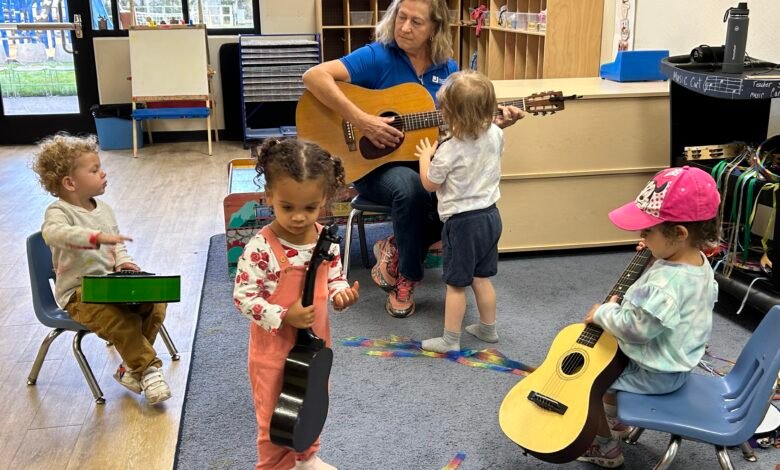
While watching your baby take their first steps or hear their first words is one of the most rewarding milestones as a parent, another crucial developmental period begins as babies transition into toddlers: socialization.
Perhaps you’re questioning, “Is my toddler old enough for preschool?” or “How can a preschool help a toddler that doesn’t know how to share yet?”
Putting your toddler into a high-quality preschool program will not only help them gain a head-start on kindergarten, but will also give them the most positive social head-start that you could ever imagine.
Below are just a few of the ways that preschool helps to develop your baby’s social skills and a lifelong habit of positive relationships:
1. The Transition from “Parallel Play” to “Cooperative Play”
Typically, at age two, your toddler is likely engaged in “parallel play”, which is playing beside another child, but not necessarily with them. Parallel play is a perfectly normal developmental stage; however, to progress, children need a bit of guidance.
In a preschool environment, children will slowly but surely progress into play alongside peers. Whether it is building blocks with others, playing in a sensory table, or rolling a ball back and forth, preschool for toddlers in Los Gatos is an environment that can easily be developed to guide them towards group play and sharing in an active way.
Through observation, mimicking others, and a little push from the teacher, your toddler will gradually begin to take part in a little happy, active interaction.
2. Sharing is an Acquired Skill
No doubt, “sharing” is one of the most difficult concepts for a toddler to learn; your toddler is a young human who currently thinks the world has been made for them.
However, in a preschool program, sharing can become part of your toddler’s everyday routine. Your toddler will quickly learn through a safe and secure environment that when they have to share a toy, they will still get to play with it when they’re finished.
Through various groups, play times, and snack times, your toddler will be guided into waiting their turn and understanding a little social contract.
3. Building Emotional Intelligence and Empathy
Social skills are deeply connected to emotional regulation. Toddlers experience big feelings but lack the tools to express them. When a toddler is surrounded by peers, they get a front-row seat to the emotions of others.
If a classmate drops their snack or cries when their parent leaves, teachers use these moments as teaching opportunities. Educators at APJCC Preschool help toddlers label these emotions: “Look, your friend is sad. Let’s see if we can help.”
This builds empathy—the ability to understand and care about how someone else feels. Recognizing emotions in others is a core pillar of emotional intelligence (EQ), which is highly predictive of future success and happiness.
4. Developing Language and Communication Skills
A toddler’s vocabulary expands exponentially when they are immersed in a language-rich preschool environment. While interacting with parents and siblings is wonderful, communicating with peers challenges a toddler in a different way.
To get what they want—whether it’s a specific toy or a turn on the slide—toddlers are motivated to use their words, gestures, and facial expressions. Preschoolers learn to listen to others, respond to verbal cues, and practice non-verbal communication, such as making eye contact and reading body language.
5. Solving problems (with support)
Conflict is a natural part of life.When two toddlers each want the red toy tricycle, a conflict will happen. In a home-based environment, parents usually mediate to fix problems right away.
In a preschool classroom, teachers will use these types of small conflicts as learning opportunities. Instead of just taking the toy away, teachers coach toddlers through expressing emotions using words in a safe place and learning how to find a compromise.
Learning to manage a little argument at 2 or 3 years old sets the stage for appropriate future behavior, so children know conflicts can be resolved peacefully.
6. Adjusting to New Schedules and Roles
A huge part of healthy socialization involves learning to interact with others who are not parents or guardians. Having the best preschool in Los Gatos exposes toddlers to teachers, teacher aides, and specialists who enforce schedules and discipline.
Children who are learning to trust and respond to adults other than those in the family will gain a sense of resilience and adapt well to new environments. They are learning that other people exist to teach them and will help their adjustment to elementary school.
Give Your Toddler the Gift of Connection
The world for your child doesn’t have to be only your house or your backyard. With a full day preschool for toddlers, your baby will enter a place where friendships and important life lessons are not only made, but nurtured.


