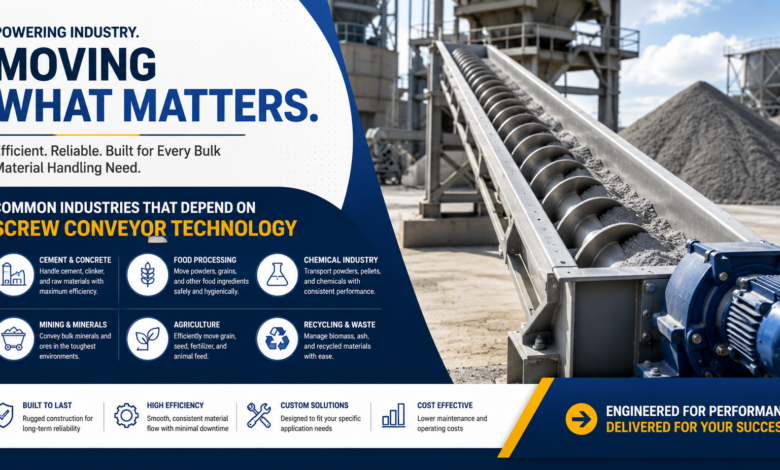
Screw conveyor technology plays a major role in modern industrial operations. These systems are widely used for transporting bulk materials efficiently, safely, and continuously across production facilities. A screw conveyor mainly consists of a rotating helical screw blade, commonly known as a flighting, mounted inside a tube or trough. As the screw rotates, materials move forward through the conveyor system.
Industries prefer screw conveyors because they are compact, cost-effective, and suitable for handling different types of dry, semi-solid, and even wet materials. Their ability to work in horizontal, inclined, and vertical positions makes them highly adaptable for industrial environments. From food processing plants to mining facilities, screw conveyors have become an essential part of material handling systems.
NOTE :- Manufacturing facilities had benefited from Screw Conveyors Suppliers in UAE by using advanced conveyor systems for safe and smooth bulk material movement. Efficient screw conveyors had supported automated operations and reduced manual handling challenges significantly. Contact Al Jarah Industries Equipments and Machineries Trading for high-performance screw conveyor systems suitable for diverse industrial applications and environments.
This article explores the common industries that heavily depend on screw conveyor technology and explains why these systems are critical for smooth industrial operations.
Food Processing Industry
The food processing industry is one of the largest users of screw conveyor technology. Food manufacturers require hygienic and efficient systems to transport ingredients and finished products safely during production.
Screw conveyors are commonly used for moving flour, sugar, grains, spices, coffee beans, salt, and powdered ingredients. Since food safety is extremely important, many screw conveyors used in this sector are made from stainless steel to prevent contamination and maintain hygiene standards.
Another major advantage is their enclosed design, which helps protect products from external contaminants such as dust, moisture, and bacteria. Additionally, screw conveyors can operate continuously, allowing food processing plants to maintain high production efficiency without interruptions.
In large-scale food manufacturing facilities, automated screw conveyor systems also help reduce manual labor and improve workplace safety.
Agriculture Industry
Agriculture is another industry that relies heavily on screw conveyor systems. Farmers and agricultural processing units use these conveyors for handling seeds, grains, fertilizers, animal feed, and harvested crops.
Screw conveyors help transport materials between storage silos, processing machines, and packaging systems. They are especially useful in grain handling applications because they can move large quantities of materials quickly and efficiently.
Agricultural environments often require equipment that can operate in dusty and harsh conditions. Screw conveyors are highly durable and capable of handling abrasive materials without significant performance loss.
In feed mills, screw conveyors are used to transfer feed ingredients through different stages of mixing and packaging. Their reliable performance helps agricultural businesses maintain consistent production and reduce operational delays.
Mining and Mineral Processing Industry
Mining operations involve handling heavy, abrasive, and bulk materials, making screw conveyors an essential component of the industry. These conveyors are widely used for transporting ores, coal, crushed minerals, and other extracted materials.
Mining companies prefer screw conveyors because they can withstand demanding operating conditions. Heavy-duty screw conveyor systems are specifically designed to handle high-capacity loads while minimizing material spillage.
In mineral processing plants, screw conveyors assist in transferring materials between crushers, grinders, screening systems, and storage units. They also support dust control efforts because enclosed conveyors reduce the release of airborne particles into the environment.
The mining industry benefits from screw conveyors due to their low maintenance requirements and long operational lifespan, even in extreme working conditions.
Wastewater Treatment Industry
Wastewater treatment facilities depend on screw conveyor technology for handling sludge, screenings, and waste solids generated during treatment processes.
Screw conveyors play an important role in transporting semi-solid waste materials between treatment stages. Since wastewater plants often deal with wet and sticky substances, screw conveyors provide an efficient and controlled solution for material movement.
Their enclosed structure helps prevent leakage, odor release, and environmental contamination. This is especially important in municipal wastewater treatment plants where hygiene and environmental safety are critical.
Many wastewater facilities also use shaftless screw conveyors because they are effective in handling fibrous and sticky waste materials that may clog conventional conveyors.
Chemical Industry
The chemical industry requires highly reliable material handling systems due to the sensitive and sometimes hazardous nature of chemical products. Screw conveyors are commonly used for transporting powders, pellets, granules, and chemical compounds throughout production facilities.
Chemical plants often use customized screw conveyors designed with corrosion-resistant materials to handle aggressive substances safely. These conveyors can also be sealed completely to minimize exposure to hazardous chemicals and prevent contamination.
Another benefit is the precise control screw conveyors provide during material transfer. This helps maintain product consistency and improves manufacturing accuracy.
In chemical manufacturing environments, automation is essential for maintaining productivity and worker safety. Screw conveyor systems integrate easily with automated production lines, making them highly valuable for modern chemical processing operations.
Cement and Construction Industry
The cement and construction industry depends heavily on screw conveyor systems for handling cement, sand, fly ash, lime, and other construction materials.
Cement manufacturing plants use screw conveyors to transfer raw materials between different stages of production. These conveyors are also essential for loading and unloading bulk materials from storage silos and mixing systems.
Construction material handling requires equipment that can withstand abrasive materials and heavy-duty usage. Screw conveyors are built to handle these challenging conditions efficiently.
In concrete batching plants, screw conveyors ensure accurate material feeding into mixing systems, helping maintain product quality and consistency. Their compact design also makes them suitable for facilities where space is limited.
Pharmaceutical Industry
The pharmaceutical industry relies on highly controlled and hygienic material handling systems. Screw conveyors are widely used for transporting powders, tablets, granules, and raw pharmaceutical ingredients during manufacturing processes.
Stainless steel screw conveyors are commonly used because they meet strict hygiene and cleanliness standards. These systems help reduce contamination risks and ensure compliance with pharmaceutical regulations.
Precision is extremely important in pharmaceutical production. Screw conveyors allow controlled and consistent movement of ingredients, which helps maintain accurate formulations and product quality.
Additionally, enclosed conveyor systems help protect sensitive pharmaceutical products from moisture, dust, and environmental exposure during processing.
Plastic and Recycling Industry
Plastic manufacturing and recycling plants use screw conveyors for transporting plastic pellets, flakes, granules, and recycled materials.
In plastic production facilities, screw conveyors help move raw materials into extrusion and molding machines. Their continuous operation supports high-speed manufacturing processes and improves production efficiency.
The recycling industry also benefits from screw conveyor technology because these systems can handle mixed and irregular materials effectively. They are commonly used in recycling plants to transfer shredded plastics, rubber, and waste materials between sorting and processing stages.
Screw conveyors contribute to cleaner and more organized recycling operations by reducing material spillage and improving workflow efficiency.
Power Generation Industry
Power plants use screw conveyors for handling coal ash, biomass materials, and fuel feed systems. Thermal power stations especially rely on these conveyors for moving ash generated during combustion processes.
Screw conveyors help maintain continuous fuel supply to boilers and support efficient waste ash removal. Their enclosed design minimizes dust emissions, which improves environmental compliance and workplace cleanliness.
Biomass power plants also use screw conveyors for transporting wood chips, sawdust, and agricultural waste materials used for renewable energy production.
Reliable material handling is essential in power generation facilities because operational interruptions can impact electricity production. Screw conveyors provide dependable performance under demanding industrial conditions.
Conclusion
Screw conveyor technology has become an essential part of modern industrial operations across multiple sectors. Industries such as food processing, agriculture, mining, wastewater treatment, chemicals, construction, pharmaceuticals, plastics, recycling, and power generation all rely on these systems for efficient material handling.
The popularity of screw conveyors comes from their versatility, durability, low maintenance needs, and ability to transport a wide variety of materials safely and efficiently. Their enclosed structure also supports hygiene, environmental protection, and workplace safety.
As industries continue to adopt automation and advanced manufacturing practices, the demand for reliable screw conveyor systems is expected to grow further. These conveyors will remain a critical component in improving productivity, reducing operational costs, and ensuring smooth industrial processes worldwide.
For More Insightful Articles Related To This Topic, Feel Free To Visit: https://ecomotion.ae/